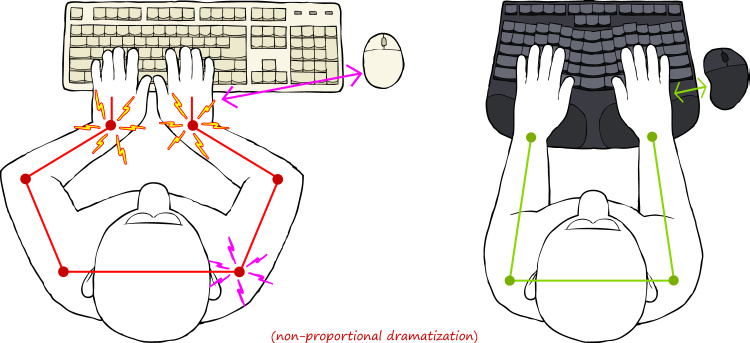
Whenever split keyboards come up, ulnar deviation is mentioned, and non-split keyboard users are depicted to be using the keyboard like this (image from the post):
I don't know if it's just me, but I don't use the keyboard like that. I know the illustration is said to be exaggerated, but still. There is no need to squeeze your hands in front of the keyboard. Just naturally bring your hands in front of chest, the same as when you are reading a book or writing notes with a pen. No twisted wrists. No ulnar deviation. The idea that you can't do something with your hand in front of the center of your chest without hurting the wrists seem like a strange supposition.
Admittedly, I've never looked at a significant number of people typing on a non-split keyboard, so I don't have the data to refute the need of this invention. I just feel like the natural posture already doesn't have the problem of ulnar deviation.
I think a shockingly high number of people really do type Z with their little finger, X with their ring finger, and C with their middle finger. It's the only way I can explain how they end up that way in columnar layouts so often.
This is madness to me. That would wreak havoc on a wrist. Type Z with the ring finger, X with the middle finger, and C and V with the index finger, just like you type M with your right index finger.
I cannot for the life of me understand the claims by ortholinear fans that fingers travel in a straight line as they expand. Mine don't. My fingers are much farther apart when I extend them than when I pull them in, and I think I have a fairly ordinary set of hands.
I do type Z with little finger, etc, because that's how the typing software I used long, long time ago taught it. But I don't accommodate by messing up my wrists, which are still in a natural position. My fingers just adapted to the needed flexibility. My left pinky hitting the Z is trivial and less effort, IMO, than my right index finger hitting Y.
And yes, I use a conventional straight keyboard, not an ergonomic one.
I’ve been a consistent split keyboard user for a quarter century now. My current daily driver is a Redox, which uses a columnar layout. I got into them when I first started having problems with tendinitis. I feel like they help, but I’m not sure what the science says about it.
Anyway, I’ve always hated that diagram because it’s so obviously hyperbolic. I also use standard keyboards on a daily basis, and while there are some posture differences, the bending to make hands perpendicular to the keyboard just does not happen. Comfortably placing your fingers on the home row requires angling your hands a bit because the fingers are all different lengths. Are there some posture differences? Sure. But from what I’ve seen they’re really quite minor.
What I would guess makes more of a difference is tenting. Which is admittedly only possible with a split design. But also, not all split keyboards do tent.
Also, and this one might be specific to my particular problem, moving keys the thumb strikes to a position that it can reach with less stretching has helped a lot. (I suspect that the space bar in particular might have been the source of most of my woes.) And that’s another variable that’s highly correlated with - but still not the same as - the keyboard being split.
Try things and see for yourself. I know that’s not super satisfying advice, but everyone has a different experience with these things so there are no easy answers.
Start small. Don’t feel pressured to dive straight into the $300 keyboards. I have a fancy custom mechanical keyboard myself, but that’s because a few years back I decided it would be fun to get into using a more hackable keyboard. For a very long time I was more than content with the (sadly now discontinued) Microsoft Sculpt keyboard, which was one of the least expensive options.
> All typing guides I’ve seen recommend keeping fingers on home row. If you do that you end up pretty close to what that drawing shows.
I type at 130 - 135 wpm with my fingers on the home row. I don't have a posture anything like that drawing. In fact I have to make a conscious and uncomfortable effort to contort my hands into that position. It's far more natural (for me) to curve my fingers to hit the right keys rather than curving my wrists so that my hands are perpendicular to the keyboard. Like this:
The base idea behind keeping your fingers on the home row makes sense, as it promises that you can reach most of the commonly used keys by just curling or straightening your fingers, without moving your wrists at all. This doesn’t appear true in your picture. How does the person reach T with a finger that’s already straight, while still keeping a finger on A?
This is obviously not an exact science and I’m sure you manage to type just fine. However, if given a choice of regular and split, I don’t see how one could argue that they’re just the same. For me personally, I used to type with a lot of wrist movement and had trouble learning true touch typing for decades, but learned it on a split in a few weeks.
I'm not sure I can answer the first question, because I can reach the T just fine with my other finger on A and without contorting my wrist. Also, not that it changes my point, but I don't conform to a rigid version of the home-row rule or the standard touch-typing method, and I think that's how I achieve faster typing speeds than most. My hands dance around the keyboard and each movement is relative to where my fingers were on the last movement, while keeping the home row as a base. For example, in the standard method you'd use the right index finger for both Y and U. For me, if I've just typed a Y, I'll use the second finger to type U because that's more natural than re-using the index finger in different positions.
Also, just to be clear, I wasn't arguing that regular and split are the same. I have both types of keyboards and I'm planning to switch to split once I've mastered a new keyboard layout. My point was only in support of the original comment; namely, that that drawing is misleading.
Yeah, I get that. From how you describe it, I think my typing style was similar to yours. It works, but it’s significantly distinct from what’s presented as proper touch typing form. In my case, the downside was that due to all the movement, even tough I knew where the keys are, I tended to hit wrong keys a lot.
Wait have you been thinking "keep them on the home row" means any finger not actively typing a key must be in physical contact with its home row key??
This would at least help me make sense of people's wrist problems. Holy cow. Never mind how much it would slow somebody down. None of my fingers is ever stationary long enough to bring it back to a specific place typing 135 wpm.
It's really quite easy to keep your fingers on the home row and avoid bending your wrists. I've done it for decades without any wrist problems.
It's even easier than the bent wrist position. Take a look at your hands. What is the shortest finger? Your pinky.
The straight wrist position lets you put your pinkies on the home row without the unnatural stretching that the bent wrist requires.
Try it: Keep your wrists straight and start by placing your index fingers and pinkies on the home row. Then let your middle and ring fingers settle into place.
You may notice that your middle and ring fingers arch higher than the index fingers and pinkies. That's fine!
Then start typing. If you're used to the bent wrists, the keys above and below the home row may not be where your muscle memory is used to. Keep at for a while and your fingers will re-learn where the keys are. Just don't let yourself slip back into the bent wrist position, and you will be back up to speed in no time.
Here's a comment from years ago with some crude ASCII art illustrating the difference:
I don't know. Hands on the home row is pretty comfortable for me. My arms are coming at the keyboard on an angle though, so there's no real wrist strain. Certainly if I kept my hands at a 90 degree angle to the front of the keyboard like in the diagram, it would be uncomfortable.
Many years ago, I was lucky enough to discover a keyboard training program called Stamina. The author suggested using a more ergonomic hand position: instead of placing your fingers on ASDF and JKL;, you place them on SDFV and NJKL. This way, your hands rest in a position similar to what you would use on an ergonomic keyboard. In addition, the characters on these keys are more frequent, so your base typing speed should increase (especially for cyrillic layout). It was over 20 years ago, and I wonder why nobody uses it and everyone still uses that uncomfortable orthodox hand position.
This is almost exactly what I do. Keep my wrists in line with the forearms, such that they're angled relative to the keyboard. So the home keys aren't ASDF, it's more like QWEF and HUIO. (Although it's more like the home position is in the crevices between those and the keys just below.) I've always done this just naturally and have never had any problems with typing stress or fatigue in 40 years.
Unfortunately, many Qwerty typing guides group keys in left-leaning columns [1], requiring many to twist their left wrist. And this is why I hope the angle mod [2] from the Colemak community gets more mainstream recognition: instead of learning to twist your wrist, just shift the keys to let them adapt to you. This "un-kinks" the layout, allowing your left wrist to remain perfectly straight while your arm approaches the keyboard at a natural, relaxed angle like the person in the right side of the drawing.
The person on the right side is sitting in a more elevated position, and so with their shoulders relaxed and upper arms at their sides, they only need to extend the forearms to reach the keyboard.
The "numeric keypad" hazard also illustrates why I was motivated to switch my Sun mouse to the left-hand side, and I reversed the buttons in my X11 mappings. This was a reliable way to perplex my coworkers.
Many-many moons ago I moved my mouse to the left side because I didn't have enough room on my desk on the right side. I became equally good with both hands and this has been paying dividends for years. Except I didn't reverse buttons, my brain just adapted and I never confuse which button to press.
There are a few keyboards out there that move the numeric keypad to the left side of the keyboard, so that right-handed people don't have to move their right hand quite so far to use the mouse. Basically, like a tenkeyless (TKL) keyboard, but keeping the keypad.
I use a Keychron Q14. Keypad on the left can be found by searching for "southpaw". The only issue I have with it being on the left is that I was used to sometimes pressing the numpad enter key with my thumb while holding the mouse. It does take a while to get used to using it with the left hand though. Maybe having it mirrored would help, idk.
Yes. I'd swear that people that unfortunately fall into RSI also fall into a negative cycle of moving less and favoring a static position at all levels - fingers, wrists, shoulders.
Our bodies love movement and it's often a recipe for solving all sorts of issues.
What gets me the most is that all the "correct typing posture" images seem to indicate that it's best to keep the keyboard low, close to you, elbows bent around 90 degrees. In this position the palms are naturally positioned so thumbs are pointing up, and you need to force the palms to be level with the keyboard (that's pronation/supination if I recall correctly). That's just madness to me, I can't last more than few minutes in that position.
Underdiscussed: The biggest difference these keyboards make: adding additional keys for the thumbs (replacing the unnecessarily large spacebar of traditional keyboards).
This allows the hands to do more with the keyboard while resting the hands on home row. -- For users comfortable adding a bit of complexity for the benefit of increased expressiveness (e.g. vim users), having extra thumb keys allows bringing the full functionality of the keyboard to within reach of the hands on home row.
For me, I think that these keyboards fix many silly design flaws of the traditional keyboard makes them interesting enough to be worth using.
Thumbs: true, but I think some take it way too far - up to seven keys per thumb! The thumb is articulated at the wrong angle to move very far, so I find that two or perhaps three keys per thumb in a single arc is about as much as I can use fast.
Yeah the thumb clusters are my favorite part of using my Kinesis Adv 360, and one of the only few things I miss when typing on a regular keyboard. Yeah the ergonomics are better but I can hit 150+ on both regular and split keyboards and never really had pain/issues with my wrists. Although I prefer the split layout more.
I’ve been using split boards since the original Microsoft Natural Keyboard, the one with the awful number pad. Then a Kinesis Advantage, then the 360. The DIY boards like a Lily58, Corne and a similar custom are mostly for travel.
Switching to split or ortholinear takes time. Doing both together is a significant and slightly annoying adjustment and takes a few weeks to feel normal. The payoff is when you lean into it. Home row mods so the home keys become ctrl shift alt meta when held, plus a thumb layer for navigation so you get vim-style movement everywhere, and a symbols layer for the stuff not on the top row.
Two thumb keys per side works well. Layer on both sides, enter on one thumb, space on the other. About 6x4 per side is the sweet spot for me. A function row on things like the Advantage 2 or Glove80 can be handy.
If you want to try it in steps, the Kinesis mWave is a decent bridge. Split but not ortholinear, full keyset so you don’t have to relearn everything at once, mechanical, runs ZMK, and in US pricing it’s very cheap for what it is, roughly $120.
I bought an mWave a few weeks ago, thinking of wading back into Kinesis, and for me it's not a fit. The key feel is garbage compared to my Keychron or my old Advantage, and the flow of the shape isn't comfy enough.
Agreed. The thumb cluster is what I miss the most from my old Maltron keyboard. I'm looking at the Dygma Defy as it seems to have the best thumb cluster of current ergo keyboards.
A split keyboard does a good job of enforcing stricter adherence to the home keys so you end up getting quite accurate at the special functions too since everything is within reach. I think extra thumb buttons on a non-split keyboard gets you all the same benefits, I'd love to see more boards explore that.
Programmability is really an awesome feature for this very reason. Even with a traditional layout, you can be really creative and improve the ergonomics: tap/hold mod for the spacebar, remap caps lock to do all kinds of stuff...
It is missing some newer designs, but it at least shows that not all split keyboards are tiny things with half the keys removed.
I've been using an ErgoDash for 6 years. I have one at home and another at work. If there had been a similar keyboard with real F-keys in 2019 I would have chosen that instead, but it's only a very minor annoyance.
If I was looking now I think I'd buy the Kinesis Advantage360 (I could keep using the layout I am now used to) or Kinesis Advantage2 (dished, but has fewer keys than I'm used to).
(If anyone keeps up-to-date with split keyboards etc and wants to take over the gallery site, just let me know. I'm happy with the keyboard I have, so I don't spend time researching more.)
I'm not sure why nobody mentions this, but for windows and linux, you can fiddle with a "split keyboard" by using two keyboards. You can put your right hand over the right part of the right keyboard, the left and over the left part of left keyboard, and ... type away. It just works, and usually it is free, almost everyone I know has a pile of keyboards somewhere.
Irritatingly, this doesn't work by default on the mac where the meta keys only affect the keys on the keyboard owning the depressed key (IE left shift and right keyboard l will not result in L).
It uses a bit more desk space, but is otherwise a pretty good way to test out "do I want a split keyboard?"
On windows and linux, yes, without any added anything holding the shift (or windows or control or alt) key on one keyboard will modify the behavior of any key with any other keyboard (I have a vague memory of getting 3 keyboards and hitting ctl-alt-del across the three keyboards, on windows, and it behaving "normally").
You need some added tools to make it work with macos, as someone else pointed out
These days I just use a single keyboard (the IBM M4-1 keyboard) and get up frequently.
I actually want to try that just to see the looks on people's faces when I'm typing on two keyboards. It's the opposite of this: https://www.youtube.com/watch?v=u8qgehH3kEQ
The issue with kinesis and all those nice small symmetrical keyboards is that not every alphabet is as short as English.
Russian, for example, has 33 letters.
So if you’re someone like that, you really want that ordinary macbook-like number of keys = larger non-symmetrical right half.
—
As for the ortholinear keyboards, I spent a few months with the latest kinesis but sold it eventually: not that comfortable.
Just clench your fist and you will see that not all your fingers are moving in straight parallel lines. I don’t buy the ortho logic at all. I would argue that left half of the ordinary keyboard is even more ergonomic in this sense.
—
Also don’t bother with dvorak, qwerty is 80/20 pareto stuff. Just isn’t worth it compared to returns.
—
Tdlr; split, traditional layout https://uhk.io/ is my best purchase: use it for almost 5(?) years. Modded it for swappable switches, lubed, what have you.
Don’t waste money for uhk riser, not worth it. Small plastic built-in legs are more than enough.
Wooden palm rest is a must though.
—
Previously was a big fan of microsoft split ergonomics (2nd gen and sculpt later)
—
BTW if you use multiple OS, map the ctrl key on windows/linux to the same place where command is on mac. Shortcuts will be the same physical keys, also it is much more comfortable to have this pressed with a thumb instead of a pinky.
Though you would want to buy a rounded key cap (like a spacebar) of you use a mechanical keyboard — it is painful to press the keycap corner with a thumb if it is not rounded.
> Also don’t bother with dvorak, qwerty is 80/20 pareto stuff. Just isn’t worth it compared to returns.
I wouldn't specifically recommend other people learn Dvorak, but I switched to it when I was in my early teens (~25 years ago) and I feel pretty great about the returns I got from that.
My kid sure isn't getting qwerty as their default keyboard.
I had the same experience, I learned it early too. My thinking was, if I'm going to be typing my whole life, I might as well do it with the bee's knees.
I also swap ctrl+caps. That caps key real estate is just too good.
It's pretty wild, I can _ONLY_ touch type dvorak. I couldn't tell you which keys are which looking down at the keyboard. And I'm fast. I'm so fast I don't even need to vibecode.
I can push 130WPM with some serious warmup on QWERTY. Even still…I can feel its inadequacy. The semicolon sitting unused under my pinky is just such a massive waste. The period there instead would be a game-changer.
It still feels bad because you most often have to jump and aim your pinky to hit enter afterwards. I guess those who write minified JS are laughing straight to the bank though.
Dvorak works really well for me. (Though you might want to pick Colemak or Neo2 these days.) I use Dvorak on both my Kinesis Advantage and on 'normal' keyboards like on a laptop.
My personal experience after switching to Colemak is mostly neutral. Speed is about the same after some training, around 70 WPM. Comfort, maybe improved a bit, but no life changing.
Some people claim that they went from 60 WPM on Qwerty to over 100 WPM on some other newly designed layout, but my experience is clear: if you do it for the speed you will be disappointed.
I'd guess the speed improvement in those cases likely came from learning a better technique, like touch typing and using more of your fingers. Afaik a lot, if not most, of the fastest typists are still on qwerty.
I've been inputting Devanagari with a 30% ortho keyboard lately using QMK. ऐसे अति मुश्किल नहीं है । I have an extra layer for nicher inputs just as I do with my usual Roman text. I'm not aware of any writing systems that normally require multiple layers. The most complex I can think of is Hangul, and they all should translate pretty directly to a smaller keyboard.
love the microsoft ergonomic kb, I have the surface grey one as my main kb (I need the full layout for various 3d program shortcuts annoyingly) but it really does feel great to type on despite not being "mechanical"
> The issue with kinesis and all those nice small symmetrical keyboards is that not every alphabet is as short as English.
> Russian, for example, has 33 letters.
Ironically, the biggest enthusiast of these splits I know in real life (he owns a kinesis) is a slavic guy, speaks both Ukranian and Russian, but I suppose he's typing in English for most of the day at his job, however I know he uses layering for the cyrillic.
Yeah, it’s two or three(?) letters that got cut out, one of them is kinda rare.
You can get used to it, but why suffer. Especially if one also uses a laptop.
Other thing that I don’t like in all these small custom keyboards is that most rely on a single spacebar on one half. I learned to use either thumb depending on which next key is: press space with left thumb if next key is on the right half and vice-versa.
—
Also I would urge you to buy a keyboard with arrows keys and extra stuff like home/end
I use uhk 40 and it is fine most of the time since I use vim-motions in my IDEs. But sometimes I just wish they were there.
For example alt-right on mac is to expand all folders recursively in the Finders list view. Just becomes an effing piano if you need to add caps-l to have an arrow in addition to all the alts and shifts.
You can mitigate this with stuff like caps + ; for alt + right arrow (ctrl + right arrow for win), but again, when you need to add shift or not only left/right it gets cumbersome once you are not in the vim-like environment (chats, word, what have you).
tldr; buy uhk 80 nowadays. And an external bluetooth numpad for those days when you need to enter a lot of numbers. Why external? Shorter distance between a keyboard and a mouse — more comfortable and takes less space.
You underestimate my friend and true keyboard nerds. We're talking 40% splits and less, two or more additional programmed layers in combination with tap key combos, vim-binds everything he can.
I don't think losing a few letters or context switching is a big concern to him anymore lol. He doesn't even type QWERTY in English, he's a colemak guy haha.
> tldr; buy uhk 80 nowadays. And an external bluetooth numpad for those days when you need to enter a lot of numbers. Why external? Shorter distance between a keyboard and a mouse — more comfortable and takes less space.
Or learn to mouse with your left hand. ;)
I used an MS ergo keyboard at my office for years with left-handed mousing since that puts the keys in the middle, mouse on the left and numpad on the right.
the uhk looks fairly close to what I've been looking for, just wish it had ortholinear keys.
how's the build quality? I got a split keyboard a while ago from a small producer, and the case was completely built out of 3d printed plastic which caused it to be pretty flimsy and kept sliding around due to the light weight.
I am an owner of a Glove 80 and I cannot overstate how benefitial it was for me. It improved my typing speed and overall comfort. Also, it forced me to type correctly, using all my fingers and place them in the correct keys.
To this day I think this is one of the best pieces of hardware that I bought.
I'm not at your stage yet, but my gut feeling is that I'll reach the same conclusion. I've bought a Glove 80 and figured that since I'm learning something new I may as well go all in and also switch to a a more modern keyboard layout (I chose Canary for it's emphasis on keyboard rolls). I love the abundance of thumb keys, and I'm planning to make good use of them in my WM and Emacs, as soon as my typing speed recovers to the point where I can function normally again.
I got one with low-force switches. It's very comfortable to type on, but between the low-force switches and slightly different layout from a regular keyboard (column-staggered, concave, symbols in different locations) I make more mistakes. So I usually type on my laptop instead, especially while coding.
If you are comfortable using the laptop keyboard what was your motivation to buy the glove80? I use that as my daily driver but if I didn't get tendonitis from normal keyboards then I wouldn't have bought it.
Keyboardio is run by a programmer who developed debilitating RSI and his wife. He tried a bunch of keyboards, then designed his own. Lots of people asked where to get one, so they refined it into a product and started the company. That was the Model 01, and I have two of those.
Having the function button located for the base of the thumb is really comfortable and useful. The swappable bases (flat linked, tented, and the separate stands) are nice to have. The link between the two halves of the models 01 and 100 uses an Ethernet cable. The stands use a standard camera tripod threaded connector, so building your own mount for a chair or armature is simple enough.
I had a warranty issue with one of my Model 01 boards. One keyswitch didn’t work reliably. Instead of sending the whole thing back, Jesse sent me four or five spare switches, some stickers, a personal note, and a page explaining I could desolder and solder the switch without voiding the warranty (as long as I didn’t damage anything in the process of course). The Model 100 is socketed.
The hardware design and the firmware are open source.
This article doesn’t mention my absolute favorite split keyboard : the Keyboardio Model 100. The killer feature for me is the palm keys that are very ergonomic, in my opinion, and I’ve never found another keyboard that offers them. The sculpted keycaps are also nice.
Does anyone know a google-able term for split keyboards that have doubled keys down the middle column (B/N, G/H, T/Y, 6/7)?
I see one instance on this page of a keyboard with double "B" key ("Alice layout"), but not the others.
I've been interested in trying a split keyboard, but I like to type those middle keys with either left or right hand depending on the moment, so all the split keyboards I've tried have ended up somewhat annoying, for that reason.
I don't think there is an actual name for that. I actually don't think I have ever seen a keyboard with a layout like the one you describe. I'm not really sure if it was really intentional on the Alice layout. The extra B might just be for extra symmetry between the two halves.
No mention of the Kinesis Advantage 360? I was lucky and scored two of them for free, one from the ergo center at my employer, and one from a generous coworker who didn't vibe with his.
There are a lot of keyboards I'd like to try, but I'm pretty happy with these.
Not to say you need every keyboard in the world in your article, but the Freestyle Pro is also nice - it's essentially a Freestyle 2 but with mechanical keys.
I resent the idea of an absolute standard of ergonomics or typing technique. I often use my left thumb to key z/x/c/v/b. I often reach with my left index finger to key y/h/b. During certain chords, my hands often cross over the split.
I tried multiple split keyboards over the period of 2 years and never grew out of these habits. I always wished, at the least, that some of the middle keys were duplicated between the two halves.
Eventually I received some permission to accept my personal "kinetic signature" (so to speak). Then the chronic wrist pain that led me to try split keyboards in the first place vanished. So I went back to using a normal tenkeyless. This led me to believe that split keyboards were ideal for some people, but that other people (like myself) are predisposed to a sort of perfectionism that entails physical guarding and chronic pain.
I still wish I had a wireless split keyboard for times when I'm supine and need to type, though.
> Then the chronic wrist pain that led me to try split keyboards in the first place vanished.
The elephant in the room with the 'ergonomics' argument for split keyboards is that you get a marginal improvement using the keyboard this way and ten times the effect by just getting up and going for a five minute walk every hour or so.
The same goes for mousephobia, which overlaps with split layout users. I still use neovim every day, but the quickest cure for the CTS symptoms that 'ergonomic' keyboard purist vim users seem to get much more than their IDE coworkers is just moving your hand to do something other than type in the exact same position for hours on end - something like grabbing a mouse. I strongly suspect that CTS in software engineers will go down in the next coming years as coding agents become more common and SWEs pick their hands up more (or just physically type less).
The same goes for back pain, if you're otherwise ablebodied enough to start resistance training it's infinitely more beneficial than whatever chair you're looking at.
There’s no reason not to try things. I’ve experienced CTS symptoms when using a regular mouse, which got fully resolved for years now by switching to a vertical one. Regardless of whether I should also make lifestyle changes, there’s zero reason to go back to an inferior mouse, just because that’s the design someone came up with in the 1960s.
Thanks for sharing. One of the challenges (always has been probably) with our heavy "influencer" culture is we tend to gloss over that what works for me, might not work for you and vice versa.
I recently switched to a split columnar layout but not for solely for ergonomics sake - I do the same things as you but with my right hand handling b, g, t, and my left hand moving over to accommodate (with "incorrect" fingering for c, and variable fingering for the whole of the left side).
My choice to move to a split was primarily motivated by a need to reset my typing style and a hatred for where the escape key sits on a keyboard (not forgetting the waste of space that is the spacebar.)
It would be neat if someone would make a zmk / qmk keyboard with five thumb keys where the space bar is. Might be the sweet spot for most.
When folks ask about my keyboard preferences, I always state that these things are personal and there is no "one size fits all". Fully realize that my keyboard, layout, hot keys, etc won't work for 99.9% of people.
However, I feel very strongly that if your body is telling you that something hurts or it is in pain, you should take action rather than right through it.
It's an ergonomic keyboard, not a split keyboard, but I have a Feker Alice 98 (highly recommended!) and it's got two B keys, one on either side of the ergonomic divider. Threw me for a loop when I first saw it. I only use the left one. :)
Yeah the handful of times I've tried a split keyboard, I dropped it because of this. Like I use a different hand for the 'y' key if I'm typing my (left index) versus yes (right index).
The only learning curve is if you don't type correctly to start with. :)
When I switched to a split keyboard 20 years ago, I realized that I used my right hand to type T and B. But it was a pretty quick transition when I kept slamming my index finger into the gap!
Surprised Ergodox is not mentioned, that's the keyboard that started the movement. Very safe pick since firmware is open source and it can be both self-assembled and bought.
It has too many keys in thumb clusters and bottom row, but you can easily remove them.
I included ZSA's other boards (Moonlander and Voyager) since they seemed to have superseded the Ergodox in popularity. But yes, it definitely was one of the first to come out. ZSA is still a company paving ways though!
I feel like the Ergodox was traditionally a lot of people's first wacky split keyboard -- but for those that stuck around, it was rarely their last. These days, there are so many better options that it's hard to recommend Ergodox despite its historic importance.
My kingdom for a split keyboard with a traditional layout. I have no interest in chording, layers, or having fewer keys. No numpad if you must cut something. I just want to spread my arms without any additional novelty. No shortage of “vertical” desk space, give me that F-row
I’m very happy with my Matias Ergo Pro. No numpad, and reduced size F-row, but otherwise normal layout plus a few programmable macro keys on the side. https://matias.store/collections/ergo
Almost. I own a Mistel MD770 which does a very similar arrangement. I strongly dislike the non standard home/end/pgup/pgdown positioning.
Had you asked me how often I use those keys, I would have said hardly ever. Now that I have to suffer that layout, I have realized they are crucial for my typing/usage patterns.
That bugged me about the Q11 at first too, for the same reason. I remapped the keys (which is easy to do) so I had Home/End above backspace, and then the three keys on the right are Del/PgUp/PgDn, and it was pretty easy to get used to without really changing my typing habits. The default layout is truly weird though. I can't imagine using insert more than end.
I bought a stockpile of Microsoft Ergonomic Keyboard for Business (LXM-00001) when they were still available, after Microsoft announced discontinuing their peripherals. I hope they’ll last me for a long time. I don’t know if the curved geometry still counts as a traditional layout for you, though. Incase, who acquired Microsoft’s peripherals IP, has re-released them, but apparently can’t keep up with the orders: https://www.incase.com/products/ergonomic-keyboard
Check out the Feker Alice series of keyboards. The Alice 98 has a full set of function keys & numpad. High quality build, too, I've been very happy with it. The one & only thing I don't like about it is it's missing the Home and End keys, but I can live without them.
It has some good aspects, but it doesn’t go upwards in the middle (so that you can tilt your hands outwards), can’t be tilted backwards, and has no palm rest. Regarding the key layout, I’m addicted to the 3x2 navigation block unfortunately, as well as to the context menu key, and have no use for a Fn modifier key. I appreciate wide modifier keys; a single-width Ctrl key like on the right side or the Alt key on the left side won’t do. And I’d really prefer having Alt on both sides. Lastly, I don’t want the arrow keys to be lower than normal (if anything, I’d rather have them a little higher up).
No the single slab of keyboard is not quite what I want. Being able to fully separate my arms feels so much better than scrunching my shoulders all day.
The F-lock nonsense isn't too awful, you get all of the keys, the layout is pretty standard, you can buy ANSI layout ones in the UK, and there's a full set of meta keys that are usefully symmetrical enough. Also: connects to PC with a wire. No batteries required. (The wonders of modern technology!)
Haven't tried the brown switches.
The red switches are quite light touch with a nice positive action. Very nice to type on for text, where my fingers can get into a good rhythm, but it's a bit too easy to hit the wrong key if I'm going for an arbitrary keyboard shortcut.
The blue switches go click, which feels great to type on, and I've found it does help a bit with the problem of hitting the wrong key (something about the more obvious multimodal feedback gets my subconscious on the job I suppose) - but I never quite got on with the slightly heavier key action.
I used to use the MS Ergo 4000, and I've found this a good replacement. The keyboard layout is very similar, as is the reverse tilt angle, and the palm rest is fine, even if it's IMO inferior to the MS 4000. (But: the MS 4000's reverse tilt stand, a single piece of solid plastic, is significantly more solid than the Perixx's little fold out things. Worth bearing in mind if you're in the habit of resting your elbows on the palm rest when in thought.)
Kinesis freestyle is basically this, they seem to have discontinued the "Pro" mechanical version in favor of an RGB l337 gam3r one but maybe you can just leave that off
I have multiple of the MSFT Sculpt keyboards. It's wireless. Comes with separate wireless number pad. Now produced by Incase. It has Windows key, but it's easy to remap.
Official name now : Incase Designed By Microsoft Sculpt Ergonomic Wireless TKL Keyboard
This is a summary of Reddit discussions and maker hacks, not of the actual market for ergonomic keyboards. Because the goal of those discussions and hacks is to be distinctive, the summary picture is fascinating but over-complicated.
Kinesis Advantage keyboards have been popular for decades and proven ergonomic benefit - mainly because the cup avoids wrist movement and the high-traffic keys are moved to the stronger thumb. Some users prefer the newer split Professional to avoid constraining arm position. These keyboards stopped my RSI cycle decades ago, and improved my speed by roughly half. (Also a US company, with fantastic support.)
Many people (including myself) use small split keyboards and are very happy with them. You don't need a kinesis to avoid wrist movement, DIY keyboards (like the corne) work just as well.
I do not buy the whole ergonomic portion for most split keyboards. It feels like a justification after the fact.
That said I used to use a lily58 and for me it was great. I have a lot of papers, notes and books on my desk. A small easily movable keyboard meant that i could have something between the keyboard halves, writing and reading without issue
I have RSI issues with my wrists. It really helps to have split ortholinear keyboards, if only because I have trained on them specifically to type without moving my wrists whatsoever (using a miryoku layout), while old habits persist on a standard QWERTY TKL. Of course, it also helps to put on really soft-springed keys (like kailh silver) — it's self evident that softer keys are easier to press.
I had initially thought that it'd be hard to use both kinds of keyboards at once, but my muscle memory for either seems unaffected when I use the other one.
I think a lot of the benefit comes from being able to shift each half as needed. I find myself slightly moving or angling one half or the other fairly often
Conversely, I'm totally sold on it. The shoulder-hunching thing is so real.
The thing I thought was ergonomic BS was the benefits of columnar/ortho layouts; everyone talked about how your fingers just moved vertically and it was so much better for them, and I rolled my eyes. But dang if it hasn't proved to be meaningfully true for me, too -- when I have to type on a legacy keyboard, I can clearly feel the pain in my fingers. (The disclaimer here is that my fingers are totally screwed up; if you don't feel pain normally, this probably matters less.)
I switched to a split keyboard about four months ago and decided to change layouts at the same time. Adapting to the split itself wasn’t particularly difficult, but switching layouts definitely takes some getting used to. After all this time I’m still only at around 30–40 WPM, so it’s not something I’d recommend to everyone.
That said, I do believe the change will add a few more good years to my career, so I’m committed to seeing it through. I went with a relatively inexpensive keyboard and a modified Engram 2 layout. The reduced finger travel and more natural arm positioning have already made a noticeable difference.
Give it another year and I expect to reach an acceptable speed as well. All in all, I’m happy with the switch.
If you don't already know about it, I recommend https://www.keybr.com/ for learning new keyboard layouts. It introduces letters one at a time and waits until you hit a threshold speed before introducing the next one. If you commit to doing 15-30 minutes a day consistently, you can get to an acceptable speed more quickly than if you try to learn in an ad hoc way.
I'm in the same boat as OP. I've used keybr and https://monkeytype.com/, and while doing the exercises, I get pretty close to the speed and accuracy I had using a standard keyboard and qwerty, but I get much worse on both fronts when typing in the real world.
Have you added back in capitals/punctuation symbols? keybr defaults to only lower case words, but there are some options worth enabling to bring speed up:
From the preferences:
- Unlock a next key only when the previous keys are also above the target speed. (This will force you to practice keys that are problematic in context, it's frustrating but very helpful for reinforcement learning. For example, I struggle with B, C, V on my split because I don't use the “correct” fingers for those keys on a standard keyboard.)
- Add capital letters
- Add punctuation characters
- Add words to lessons (move it to the max)
Regarding getting much worse in the real world; IMO this isn't discussed enough. When you're relearning muscle memory, it's a very different beast to copy what you see (focused only on where your fingers are) as opposed to focusing on your thought and your fingers just “go there”. I, too, have found my speed plummet at first; at some point I decided to just go cold turkey and suffer being rather slow – trading it for eventual mastery.
In my case, because I was such a phenomenally sloppy typist, sometimes what felt slow was likely just as quick as a result of making fewer mistakes on the new split layout where my behaviour was forced to be better.
Yep, I've adjusted the settings, and that has definitely helped. When it comes to real world typing, it feels like I'm using a ridiculous amount of brain power to get the word out of my head and onto the keys.
Well, I don't see these sites as a complete solution. They're a way to get you from zero to "I can actually manage to write something, even if it's a bit awkward and slow". Once you cross that threshold, you make the switch and you learn by doing until you improve to an acceptable level.
Been using split ergo since original ergoxdox drop. Currently using lily58.
If someone wants to go down this rabbit hole (I did because I had pain from writing my first book), I think the Voyager is the best option.
One thing I hate about the lily58 is the lack of decent cases. The plates are too flexible. I have a 3D printed case from etsy and the keys continually pop out of it or get finicky about seating and registering a click.
However, these days I'm typing much less. Voice recognition is so good that I generally press a button to start recording, press it again to transcribe. Then press another button to paste, press it again to hit enter.
There are a bunch of aluminium Lily58 cases out there, they're not cheap tho.
Most of the time keys popping out means your plate is too thick or the switch holes aren't a good fit. You can often improve it (and the sound) with some foam between the plate and the pcb - you can buy laser cut neoprene plate foam for lily58s, or you can always freehand it with a knife and a sheet of 2-3mm foam (it's not that hard and doesn't have to be perfect).
Shameless plug but I'm a doctor who made an ergonomic split keyboard called the TAIKO-01 (https://taiko.taikohub.com).
It's split in two so you can position them at shoulder width. It's angled so your wrists are in more natural positioning (reduced pronation), and curved to prevent finger overstretching (finger joints have arc-shaped range of motion). It's injection molded and hot-swappable.
I've been working on this since 2022 and am getting close to launch. It's gotten very good feedback from beta testers.
Looks great! What do you use for mouse though? I wish more split keyboards had some integrated pointer control (touch / trackball / thinkpad-like-stick) so I didn't need to move my hand all the time.
Wow, I wish I read this guide months ago when I was trying to research split keyboards. It would have been a lot easier to see what the options are. I eventually settled on the nocfree keyboard and have been relatively happy with it. It definitely helps by letting me split the keyboard very wide and open up the shoulders and back (slightly wider than shoulder distance). It feels like everything these days is trying to squish our shoulders/back into a hunched position. As someone with back issues, I have to mindful of my posture. Split keyboard + adjustable standing desk is great for the scapular area and the lower back for me
If split keyboards still don't cure what ails ya, try getting into the habit of not wresting your wrists while using a standard keyboard instead. I tried splits for about a decade, but all it did was move the RSI pain to somewhere else. I switched back to standard about five years ago, and worked on my typing posture instead. I used to go to the physical therapist every other week for my hands, but haven't been back in years.
Maybe I am the odd man out here but I have a Kinesis 360 Pro and legitimately my wrists and hands hurt after using it, vs my 60% tkl that I just move around throughout the day.
I really love my moonlander, the added benefit of being able to customise it specifically to my own taste has been a total game changer.
It is hilarious when others try type on it, if they can manage to get their head around the split they still have no idea how to 'use' it due to my custom layers and bindings.
But I have one big question -- why aren't the "middle" keys replicated on both sides of the keyboard? That is, for example, why not have two 'g' and 'h' keys? There are always times when you have to adapt; when you're holding down a tricky combination of alt-ctrl-shift keys or something where on a flat keyboard one would just reach with the "wrong" hand to hit a middle key; why not just replicate them?
It's pretty common for Alice-style keyboards to have two Bs (the one in the pic in the article does) as on a normally-staggered keyboard the B key is basically equidistant from the home keys so it's common to use either.
But it would be a bit of a problem for keycap sets, some come with extra Bs to accomodate Alice keyboards, but none that I'm aware of have extra G/H/T/Y. That would mean you'd be into buying two sets or using weird keys, so it's probably unlikely to be a popular choice.
That said, there's so many custom keyboards out there, and it's easier than you think to design and build your own - if you feel strongly about it go for it.
I did have that problem a little when learning to type on a split, but I very quickly corrected after hitting the table a few times haha. I actually think it's arguably easier to learn to type on a split as it'll quickly force you to break some bad habits.
If you want to do that, you can set many keyboards up to do exactly that. They just need to run the standard software - QMK, ZMK or Vial. You'll need to pick a keyboard with enough keys, of course, but there is plenty of choice. However there are other ways of solving the problem, e.g. a single key that is mapped to produce that combination. It's a matter of taste and experiment, and there is no reason for you to do it the same way as anyone else.
The reality is that you need to ask yourself wether you want a hobbyist' tool or a more common one for the same result.
Logitech's ergo k860 is affordable, has a palm rest (most mechanical keebs don't), and has an excellent ergonomical shape. And works right out of the box, with Bluetooth enabled.
The keys are membrane-based, which some may dislike because they are not mechanical - but it's actually more ergonomic, as they require much less pressure and travel length to achieve an input, meaning less wear on your fingers.
Membrane is not inherently more ergonomic, the "much less pressure" seems untrue since apparently it takes 50g of force to activate, while you can easily find switches that activate at less than 30g (I used a 37g switch myself).
About travel distance, this is also something you can adjust, with the low profile switches having less than 3mm travel distance.
Heck, even HE keyboards can set their actuation down to 0.1mm, if that's your thing.
Yeah you could probably customize a bespoke keyboard to match it. That said, the result would be pretty similar, for a lot more money, and time.
As I said, it's a hobby - I built one myself, it's nice, but the whole "ergo" aspect seems more a consumerist justification than a real concern honestly.
Make sure you can return the keyboard if you decide to try one out.
I found it wasn't for me (too big, uncomfortable, keys too far apart, harder to type without looking IIRC) and the company (in Canada) refused to issue a refund and I was SOL.
I have shoulder issues and use a Kinesis Freestyle 2. It lets me keep my shoulders square while I am typing. I would love to get a keyboard with a trackball, though. Moving from the keyboard to the mouse and back starts to irritate my right shoulder after a while (have had rotator cuff surgery on that one).
I wish I had that much typing to do that I could rationalize the expense of such a fancy keyboard :D
Also, unfortunately for the high price point it's too hard to actually try those out somewhere. Maybe works if you have friends, but I'm not going to spend hundreds on sth only to find out it doesn't work for me after half an hour. There's probably an option to send sth back, but even that is going to be a nightmare with small vendors.
I don't much understand the obsession with keyboards but I appreciate the post. It's much more than I expected for a beginner's guide. If I ever feel like trying one out, I will start from here.
I have both a ZSA Moonlander and Voyager. I've used the former for five years or so, and the latter as a travel keyboard for about a year. I'm super happy with them (obviously happy enough to buy a travel version).
I switched to Dvorak at the same time that I switched from row staggered keyboards (so five years ago), and I must say, if you're thinking about switching layouts like that, there is no better time than when switching to a wildly different keyboard. My Dvorak muscle memory is entirely tied to typing on a split, columnar keyboard, and my QWERTY muscle memory is entirely tied to row staggered keyboards. I have never used Dvorak on a row staggered keyboard, and I have never used QWERTY on my Moonlander or Voyager. I think that's helped with maintaining my ability to use standard QWERTY keyboards after not using them regularly for years.
Good coincidence, yesterday I switched to a split keyboard. I had been programming since 2011.
Main reason for my switch is that I felt that my shoulders have a wider stance than before. I don't know if it's because of an improvement in fitness (I do a lot of shoulder and back work), or maybe with age I lost a bit of shoulder internal rotation mobility.
Either way, the learning curve was like a few minutes for me. Guess it's a perk of experience and the habit of touch typing.
Neat article. I used to daily drive a ZSA Moonlander but it got unwieldy with desk space taking notes on my laptop as well. Recently tried it again, and some of my muscle memory is still here - though all the second layer shortcuts I've forgotten. In particular, what the lesser used keys on the thumb cluster map to.
If I was coming back to a smaller keyboard, I doubt I would even know where to find punctuation.
My two cents: The Keychron Q11 is a decent choice for a split keyboard which also has a traditional layout and therefore doesn't require any learning. If you don't like the distance, you _can_ push the pieces back together and they'll just resemble a traditional keyboard. And it's definitely the highest build quality of any keyboard I've used this far in my life.
It seems to have this issue (or maybe Macbooks do? I don't know..) where, waking my computer from sleep, the right side of the keyboard doesn't work. It's quickly fixed by unplugging and replugging the right side of the keyboard into the left, or unplugging and replugging the entire keyboard into the computer.. it's a shame that I have to do that sometimes, though.
I have the Q11 too (and I fully agree with your appreciation of it), but I'd like to say that I never had this issue with the keyboard. I _do_ have it connected to the laptop (tested both on a M2 macbook air and a M4 Pro macbook pro) through a `ThinkPad Thunderbolt 3 Dock Gen 2` -- not sure if that may be what's avoiding your problem.
I recommend protoarc split keyboards is you like split and FLAT. They’re so easy to travel with and charges via usbc. The best one I’ve had and I’ve had a number of split keyboards!
There really is no going back when you go split and tented. I've was on a Kenesis Freestyle for years, then upgraded to a Dygma Raise (V1) about three years ago. It's served me well, but I've been eyeing a CyBoard Imprint, which is like a Dactyl or Charbydis, but has hot swap-able switches (a rarity for curved key-well boards.) Can't give up my holy panda switches. :)
I've been rocking the Dygma Defy since it came out and it's been amazing. Their software has been buggy though, and left me rebuilding key maps more than once. I just wished it had a rotary dial
I went back - really don't like the wobble of the Kinesis keys. Ironically I prefer just an Apple keyboard since it matches my laptop (making going back and forth easy).
I built one of these and I really wanted to love it, but in the end gave up because I just couldn't get comfortable with 3+ layers. On the lookout for a reasonably aesthetic TKL split - at least until I give in and make my own.
So after almost 50 years of hacking, I'm starting to feel it in my hands. But I don't have any wrist problems -- no carpal tunnel. What I have is tendonitis in my fingers, primarily in my middle fingers and my right pinky (from slamming Enter several million times).
I've had steroid injections into the tendon sheaths of my fingers a couple of times, which hurts like a bugger when it's done but definitely improves things after a few days. It isn't a cure, though, and my hand doctor thinks I'm going to need surgery eventually.
I have to assume that a split keyboard won't help this. Is there anything that might, short of a voice interface?
Suggestion, don't use your pinky. I haven't used it for over a decade. Instead, move your whole arm as a unit, and primarily use your index finger. It takes some adaptation, but movement is better than stillness the vast majority of times.
As for the tendinitis, have you tried physical therapy for your fingers? Whenever I've had a stupid day of overusing the thumb with my phone, I wrap the smallest possible elastic band around my thumb, and do some curls. Slow and controlled. The mixture of force, movement and stretching feels great, and the issue is gone.
A split keyboard might still bring you some relief. Modifiers/enter/backspace/etc are usually moved away from your weakest fingers (pinkies) to your strongest (thumbs). I have Ctrl, Alt, backspace, delete, space, enter and shift all on my thumb clusters.
The rabbit hole goes very deep. Another option is home row mods: https://precondition.github.io/home-row-mods. A combination of thumb clusters and home row mods can reduce your finger strain a lot.
Also the type of the key matters for tendonitis. Some have tactile feedback after the key is pressed but well above the bottom so you learn not to bottom out with force.
Lead times are long, and Kinesis products are expensive. It gets a little more bearable if you take into account that you're using this tool 8 hours a day for years and years, but still. Cheaper options exist.
I can't second Kinesis enough. I have been using them for 20 years now. I was starting to have issues and I haven't have a single issue with my hands or wrists since changing over. Also a good vertical mouse will help if you use a mouse much. I use trackballs or vertical mice interchangably.
One thing to try is to sleep with your hands underneath your pillow in a prayer position. If your hands tend to curl the fingers while you sleep all night, that causes real issues eventually.
I forget the name of the layout (the board is a Lily58), but my keyboard does away with the staggered key spacing and has keys aligned vertically with a subtle bowling. You're usually pressing keys with your pad, not the sides or tips, and I suspect it would be even better with flat low profile keycaps.
There are some styles of "chording" keyboards that might help too, and some that would be way worse. Chording keyboard are also wildly different to regular keyboards, totally alien by comparison to just splitting a keyboard.
Maybe a low-profile keyboard with very-light actuation switches could help. Also choc keyboards have less spacing between the keys than traditional MX keyboards, which should required less finger travel.
Using a thumb key for Enter, would definitely help with your pinky.
Ok, fellow old hacker here. I have a similar problem and I found that a lot of the hand pain was from mouse/trackpad usage. My hands have been a lot happier since going to a trackball because I don't do nearly as much gripping and pressing.
Personally I prefer a keyboard with a gentle curve rather than an actual split - the old Microsoft Comfort Curve 2000 was my favourite for many years, but mine have all failed with membrane issues now.
I'm probably going to end up building a custom board with the features I want (gentle curve, ISO layout, nice switches) since what I want doesn't seem to be available off-the-peg. (The X-Bows keyboards are quite nice, but ANSI-only - I've done enough programming to have learned that I'm not prepared to compromise on the position of "\"!)
Built a Corne with low profile switches last year and the small key count felt impossible until home row mods clicked. Once you train the muscle memory for mod-taps on ASDF/JKL;, you stop reaching for corners entirely and the 42-key layout starts feeling like enough. Honestly the split itself was less of a revelation than remapping my fingers to treat the home row as a modifier layer.
Last time I tried home row mods I could not get over how bad it felt having the letter not appear until I lifted the key rather than immediately on the keypress. Am I just overly sensative or is this just something you get used to over time?
I had a much better experience shifting them down a row so they’re “bottom row mods”, since those keys (if using QWERTY) are much less frequently used.
There’s also features like chordal hold and flow tap which have improved the home/bottom row mod behaviour.
My wife bought for me MoErgo80 for Christmas and now I probably look like retard on Teams typing two sentences for 5mins.
But it looks nice. Feels nice. Configurability is great. I configured most used Rider shortcut for formatting file via they editor and it is even easier then normally.
But the learning curve is terrible. And it is even worse when you constantly changing the layout because you are not happy - and you have to learn it again. So it is a bit like being audiophile versus listening just for fun.
I tried to use a kinesis but my problem is that I don't touch type I learnt from scratch as a kid. and it's insanely difficult to adjust to only pressing certain keys with a certain hand/finger
I started with two finger typing taught myself from entering Basic listings into early computers, but I didn’t find it difficult to switch to all finger typing once I decided to use all of them. A little bit of time with a typing tutor helped solidify my skills but I was doing fine without it.
One of the split keyboards pictured has only 46 keys. I use a bfo9000, a split keyboard with 54 keys per side. My layout is very similar to a standard layout, sacrificing some ergonomics for transferrable muscle memory.
I'm mildly interested in keyboard ergonomics and efficiency, but every time I read threads like this I can't really see me spending $200+ on a keyboard when there are quite functional versions at $10 (and I know that the vast majority of the world is typing on either those or a laptop keyboard). To me it reads too much like an audiophile discussion about whether the materials of the cable affect sound, or just people "playing" (similar to cyberdecks). Not just trying to be provocative here, but those prices just seem crazy and just Silicon Valley posturing. Is there a post here that is not partially signalling "I'm rich enough to splurge in an unreasonably expensive set of keys"? Or am I being too harsh? The most grounded take seems to be easterncalculus's "https://news.ycombinator.com/item?id=47083354" where he mentions that the best approach is to rest and exercise a little bit instead of having led-colored chording keyboards.
There are much cheaper Microsoft ergonomic keyboards, even if the 2 keyboard halves are not separate, so you cannot adjust the distance between them or the lateral tilting.
I had been using for many years Microsoft ergonomic keyboards and it was still much more comfortable than with a classic keyboard.
A few years ago I have switched to a really split keyboard (Kinesis Freestyle), which was an improvement over Microsoft, but not a so great improvement as Microsoft was over a standard keyboard.
Unfortunately, Microsoft has first discontinued their cheapest ergonomic keyboards, which had almost the same price as standard keyboards. Then the remaining more expensive models have been sold to Incase in 2024, so they can now be found "Incase Designed by Microsoft" products, but at significantly higher prices than when they were made by Microsoft. Even so, they might be the cheapest ergonomic keyboards of decent quality. Microsoft still sells a "Microsoft Surface Ergonomic Keyboard".
Old stock cheaper Microsoft ergonomic keyboards may still be found at certain shops.
On eBay and the like a lot of old and very cheap Microsoft ergonomic keyboards can be found, but buying a "pre-owned" keyboard is risky, as you do not know how worn out it is. Moreover the wireless MS keyboards used proprietary USB dongles paired with the keyboard. If an old wireless keyboard is sold without the dongle, it cannot be used unless it also has a wired connection.
For someone who types all day, there is a great difference in comfort and fatigue between a classic keyboard and a good ergonomic keyboard. Young people typically do not care much about the quality of their keyboards, pointing devices and monitors, but after decades of using computers every day many of them regret their negligence, which could have avoided unpleasant health problems.
Mechanical and Ergonomic keyboard prices suffer because they are niche and way lower volume. The switches are not that expensive if you use common ones, but if you want some special keycaps, prepare to fork some good money. Most of them are made in very low batches and most of the expense is in the molds you have to make.
Your $10 keyboard is probably so mass produced that literal millions have been manufactured. Versus custom-ish keyboard designs that are made for at most a thousand buyers.
It's very much a hobby, like audiophiles, but also like tricking out your car. It can be expensive. It's more than the average person needs. It's fun picking out parts and being part of a community.
There's also a perspective bias that most mechanical keyboard content you see is not made by people who found a keyboard that made the wrists stop hurting and then went on with their life. The people enthusiastic enough to make content are also the people that have a bunch of tricked out keyboards.
I found it easy to adapt to the x-bows keyboard (column staggered and splayed). The thumb buttons and large ctrl, alt, space are great for emacs. My only complaint is that the braces are a bit far away.
I was looking into split ergos a while ago but was bummed by the audiophile-ness of the userbase when doing research. I don't have time or interest to learn new layouts or keymaps or whatever.
Any suggestions of simple split mechanical keyboards with standard (row staggered) layouts that aren't a small fortune?
Goldtouch Elite is the gateway drug. It offers both a hinged split and tenting if you want it, while having the classic keyboard layout. Microsoft natural also requires very little learning curve, assuming that you don't use the wrong hand for some of the middle keys out of habit.
I use Kinesis Advantage2. I suppose they should be relatively cheap on eBay now. They still have a slight amount of ulnar deviation, but I find it's the best keyboard I've ever owned. I don't use all the macros and foot pedals and whatnot. You don't lose the ability to touch type on a standard keyboard, and it really only takes a day or two to have some proficiency, and maybe 2 weeks to get to full speed on the Kinesis. It helps greatly that all the letter keys are the same; it's just the thumb keys and the arrow keys that take some getting used to.
One massive advantage of the old Advantage2 is that there's a big empty space in the middle (with just the indicator lights). You can use museum wax to stick an Apple trackpad there, and then you hardly move your hands at all. I still have a trackball for large mouse movements or whatever, but most of the fine movements are done on the Apple trackpad at the center of the keyboard.
Probably not a great suggestion these days. Back when I first got carpal tunnel / RSI (1995), I was using an IBM model M - which I loved the feel of. I had a dream of cutting a keyboard in two and hanging two halves off my chair so I could drop my arms to my sides and type that way.
Anyway, after trying a couple of things, Microsoft Natural (the original with backtilt) saved my programming career. I still have "weak" wrists/fingers/forearms, but it's rarely painful enough for me to have to stop working. Adding in some stretches generally makes it so I can survive.
I can type on a normal keyboard for maybe 15 minutes and maybe an hour on a laptop before I just can't anymore. I can generally go most of the day on my Microsoft Natural. Retraining from a regular keyboard layout (took typing in high school - yes, I'm ancient) wasn't hard at all - it's basically the same.
Sure, it's technically not a "split" keyboard - it's still one thing. These days, I buy used examples off ebay, usually 3 at a time, and on some, the typing action is horrible - but I still have a couple of examples that are usable. And I had to find the right ps2->usb adapters for my work setup. If I ever totally run out, my professional coding days are probably done.
Crazy suggestion, just connect two normal keyboards. Particularly if the left one is numpad-less you’ll get much of the idea for sure.
They might be a smidgeon further apart than might be ideal, there’s some ugly duplication… which happens to enforce a minimum distance… just get that shoulder opened up and start evaluating. It’s certainly likely to be more optimal than the status quo.
Might need Karabiner on macOS to keep shortcuts working.
I have a pair of Freestyle2 keyboards, both are over a decade old. I strongly recommend the V3 tenting kit. You can get a refurb USB Freestyle2 with the V3 kit for $70 direct from Kinesis.
Learning the new layout can be vastly accelerated by doing typing practice slowly, instead of trying to do 100wpm and crashing out. Doing it slowly makes the same brain connections, and you can exponentially ramp the speed up once you get slow reps in.
Same principle as slow practice for music instruments.
I recommend protoarc’s keyboards. They are the flattest and lightest and yet still ergonomic I’ve ever had and chargeable by USBC. It’s so easy to bring it with me even with a laptop in the backpack.
No, some are very portable. I use a Totem which is a 38 key split. It's very compact and fits into a small case I could easily just carry by hand if I wanted to.
I just use whatever laptop/tablet-type thing I have at the time.
My proper desk set up is just so much better than anything portable (not just keyboard, but also monitors, trackball, lighting, etc.) that it's not really worth doing any "real" work on the go - so while I have a number of portable devices, they're effectively just for doing stuff that can't reasonably wait until back at my desk.
(For that matter, I've effectively ditched all of my "work-capable" portable devices - my largest-screen portable devices are a Chromebook and a 13" cell-connected iPad w/ Magic Keyboard. They're both very capable devices in their own rights, but I'm not going to try to do <day job work> on them.)
If you don't mind looking like a blade runner extra who's gone missing while working in public, there's not much difference carrying these around. The moonlander is a great portable option. Just slip it in your laptop bag.
I quite like it because it gives me a bit of flexibility on where I put them, and gives me a bit of extra room in the middle. Great for a small airport table or whatever, can even use them rested on your legs
I got the Kinesis Gaming split 5 years ago and honestly it has been a game changer. My wrist pain went away, takes about a week to get used to it but it has been a welcome change. I also feel like I can type faster on it.
My shoulders are pretty wide for my frame. When using most laptop keyboards and many standard keyboards, I have to tuck my shoulders in and twist my wrists. This was causing some serious pain and tension in my neck, shoulders, and wrists, likely leading toward carpal tunnel.
I made two different changes in succession that helped greatly (and I don't remember the order now):
1. With a split keyboard, the halves could be placed so my wrists are straight and my arms hold at shoulder-width, and this rapidly reduced the amount of tension I was experiencing and gradually eased my wrist issues. Tenting the keyboard and getting a vertical mouse helped as well, but I'd rate those as minor improvements, especially since I aim not to drive with the mouse as much.
2. With Colemak layout, I was able to gradually transition from QWERTY (there's a series of AHK scripts I found at the time that basically rotated triples of keys). This helped reduce wrist strain at the hand level.
For many years I have used very cheap Microsoft ergonomic keyboards (discontinued some years ago), which were already much better for the position of the arms than standard keyboards.
Then I switched to a truly split keyboard, which is even better.
I have also switched to Dvorak a few years ago. A couple of months were needed until recovering and then exceeding the previous typing speed, but it was worthwhile, because the comfort of typing has greatly improved. Now I regret that I have not done this earlier.
It seems pretty obvious to me that it can't be worse, considering you could still put the two halves in exactly the same position as if they were attached.
completely anecdotally (sample size of one!) but I found big improvement in comfort and posture when i moved to the kinesis ergo (split, but joined) about 15 years ago.
Eventually I moved to a full split, positioned quite some distance apart (~25cm) and found that even more comfortable.
Always hard to know with stuff like this if you are just imagining it, but for various reasons, I'm pretty convinced it was an improvement for me.
By what metric makes a keyboard "best"? It's crazy subjective, and objectively diverse as we are all shaped differently with different levels of injury/wear etc.
Who cares if it's "better" if it's working better for you?
One thing I internalised when speaking with a physiotherapist is that part of avoiding serious issues is making sure you don't stay in the _same_ position for too long. One good ergonomic position is an excellent start, but changing your position several times throughout the work day is even better. This apparently helps avoid building up strain and inflammation in pinch points, balancing out the fatiguing action more.
I have found that my Ergodox allows me to juggle my keyboard halves around the desk at different angles and spaced apart at different widths, and I can put my trackball either to the right of everything or between the halves. It's a single anecdote, obviously, but I have been able to make my ulnar and carpal entrapment issues mostly go away by finding better positions while working and by not staying stuck in one posture or position for too long at a time.
I'm using an old Marquardt Mini Ergo(modded to ps/2-usb meanwhile) which is split, but fixed. Either I am so used to it by now, that I don't want to use anything else, but that is not how I remember it when I got it around the year 2000, or slightly before that. It felt like it was made for me!
But I'm not sitting like a robot in front of it. My office chair is set to sviveling back, which I often do. I'm even exchanging that chair for an inflatable big rubber ball to sit on, from time to time.
Depends on the amount of effort you put into them, and the kind of work you do on the computer. Regular users should stick to regular keyboards. Power users (like programmers) can spend a few months with a split keyboard and customize their layout and come out the other side with a personal brain-computer interface (fingers + keyboard).
Intensive keyboard used caused me two problems: soft tissue overload in my palms and elbow pain. After trying Microsoft Natural 4000, Kinesis Advantage 2, I finally settled on ErgoDox EZ with Kailh Silver switches.
These switches don't require much force to activate, and I retrained myself to type lightly. This made the palm issue go away. For my elbows, physical therapy and foam rolling made the pain go away. I keep it away by ensuring proper posture when sitting: bending my elbows without turning my forearms inside (like the person pictured on the right in the article) and tilting the keyboard to minimize wrist rotation. I believe this helps minimize tension in the ulnar nerve. If you want to feel that tension then try a few reps of ulnar nerve flossing!
1. Colemak as middle ground between QWERTY and Dvorak.
2. Command, Shift, Alt, and Control keys on both sides of the keyboard. I'm Polish and a standard keyboard layout forces you to use the right alt + letter to type diacritical characters (for example ą is Right Alt + a). This prevents you from typing with proper technique, but having two equivalent Alts solved the problem.
3. Hyper (Command + Shift + Alt + Control) and Meh (Shift + Alt + Control) on both sides of the keyboard. I use Hyper for system-level shortcuts (e.g. Hyper + A is Sublime Text; Hyper + Q is Sublime Merge; Hyper + Z is Ghostty) and Meh for application-level shortcuts (e.g. Meh + 2 is a two column layout in Sublime).
4. I have dedicated keys for (), [], and _, so that I can type them without modifiers.
5. There's a function layer with function keys from F1 to F24 - useful for switching panes in tmux!
6. A dedicated mouse layer helps me reduce my mouse use.
If you want to improve your workplace ergonomics I suggest taking an iterative approach and making full use of customization abilities in the software and hardware you own.
I also made a special belt for my keyboard: each half had it's holster and I was able to type standing with my arms and wrists completely straight. This helped a lot with alleviating elbow pain.
Take a look at ZSAs oryx configurator for Voyager (52 keys) - you'll see some general configs and development ones etc.
In general, for my moonlander I would have the first layer with all the normal alpha numerics and a few symbols like <>?
But the second layer would contain most symbols, arranged/grouped in a manner which was natural for programming - e.g. grouping keys together like (), [], {},
I've got a moonlander as well (typing on it this very message), and while typing 'clicked' for me in general, I still miss the additional keys of a normal keyboard. I customized mine as well to match my needs, but I don't have a good spot left for '[' and ']'. Have them mapped next to 5 (right) and 6 (left) but that's just as awkward to hit as the normal position they have on the keyboard. Same with "F" keys. Having to press a modifier instead of having just another row on top is a bit meh.
Hitting ALT+F1 in intellij is gymnastics for my hands. alt is super low, modifier for F keys is on the left edge of the right keyboard, and then I need to hit "1" as well.
And there's lots of other little cuts like the ones above with the moonlander. I still enjoy coming back to my MX Master mechanical from logitech for that reason every now and then.
I used a Kinesis Advantage for YEARS AND YEARS until I let it go ahead of a x-country move last year. It needed a bunch of repairs at that point, and I had drifted into using a different keyboard, so it seemed rational.
Since settling in our new home, though, I've been kinda pining for another one. The disadvantage of the KA though is that it's huge on the desk. The 360 seems like it might be a BIT more space efficient, but I haven't pulled the trigger on anything yet.
I was on the Ergodox Ez for many years which is also quite big. I was unhappy with how much space it took up on my desk. I switched to a Totem keyboard, a 38 key split, and while it took a while to get used to and feelings of doubt, I've eventually become very happy and settled on this keyboard. It pretty much solves all of my needs and I don't have too much interesting in further experimentation. I did want to try the 360 because I like the key wells, but was put off by the size of course. But I did discover keyboards like the Skeletyl which I was tempted to try. Maybe something like that or a dactyl manuform would interest you?
I moved from a regular keyboard (freestyle hunt-and-peck) to a corne (touch typing), ditching qwerty for Colemak Mod-DH. It took me six months to really get comfortable with it. At month four I was almost ready to kick off the training wheels (the training wheels here being the layout printout I looked at while typing).
Five years later, I have no regrets. It's easily the best thing I've done for productivity, ever. My fingers are my BCI. Effortless.
I keep the two halves far apart: wider than my shoulders so my arms are angled outwards and my chest is up and I'm sitting up straight. And I modified the keymap to work just the way I intuitively expect it to.
I can still type ~60wpm on qwerty on a standard keyboard. My phone is qwerty and I have no issues typing on it. Muscle memory of my posture and arm position makes this possible.
Saw this in a YouTube video of an old tech TV program episode. It was a failed product. Maybe single-handed keyboards could come back as an inspiration for modern versions?
My hot take: go to https://www.zsa.io and buy either the Voyager or Moonlander. They're both excellent, well built, offer integrated training, and you won't have to worry about anything else.