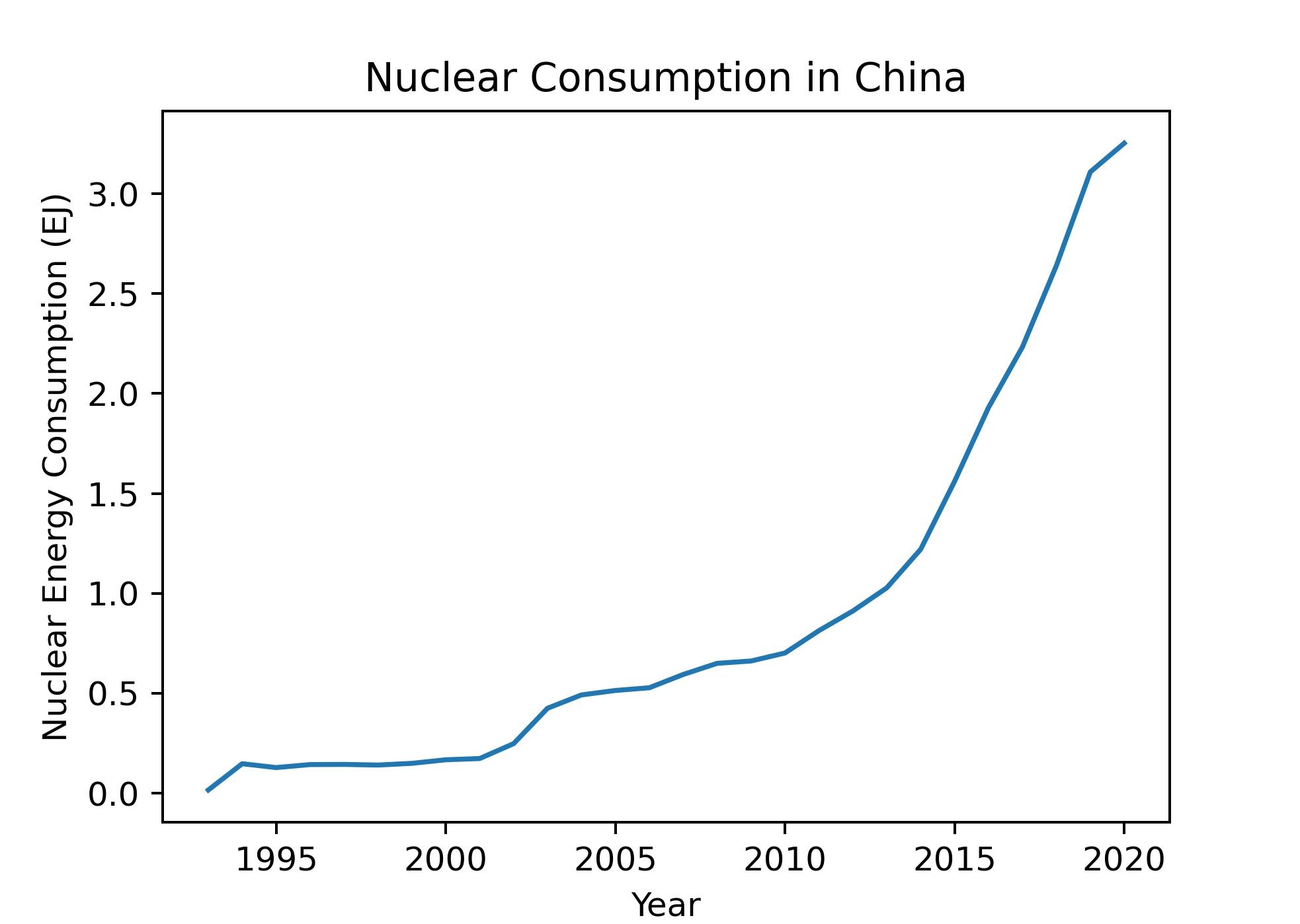
In 2020, China made a commitment to the world: to peak carbon dioxide emissions before 2030 and strive to achieve carbon neutrality before 2060. Last year, China announced its 2035 Nationally Determined Contributions (NDCs) for addressing climate change.
"The outline draft clearly emphasizes actively and prudently advancing and achieving carbon peaking, proposing that during the 15th Five-Year Plan period, carbon dioxide emissions per unit of GDP will be reduced by 17%, and a preliminary clean, low-carbon, safe, and efficient new energy system will be established. This clear roadmap will help us achieve high-quality 'dual carbon' phase goals and lay a solid foundation for carbon neutrality," said Wei Yuansong, member of the CPPCC National Committee and Director of the Water Pollution Control Laboratory at the Research Center for Eco-Environmental Sciences, Chinese Academy of Sciences.
from: https://www.news.cn/20260305/7ad8d5ee3a6d4b28b1b62230199f1d0...
this is in china's next 5 year plan
https://scholar.google.com/scholar?hl=en&as_sdt=0%2C39&q=gra...
Not a perfect measure of whether this is a reputable article but at least readers should know this isn't from some randos in a basement somewhere.
Climate data is inherently noisy, and there are multiple interconnected cyclic signals, ranging from the "adjusted" factors to cycles that span decades, which we don't understand at all. "Adjusting" for a few of these, then doing a regression over the subset of the data is classic cherry-picking in search of a pre-determined conclusion. The overall dubious nature of the conclusion is called out in the final paragraph of the text:
> Although the world may not continue warming at such a fast pace, it could likewise continue accelerating to even faster rates.
They're literally just extrapolating from an unknown point value that they synthesized from data massage, and telling you that's a coin toss as to whether the extrapolation will be valid.
I am not a climate scientist so you can ignore me if you like, but I am "a scientist" who believes the earth is warming, and that we are the primary cause. Nonetheless, if I saw this kind of thing in a paper in my own field, it would be immediately tossed in the trash.
[1] You can't actually adjust for these things, which the authors admit in the text. They just dance around it so that lay-readers won't understand:
> Our method of removing El Niño, volcanism, and solar variations is approximate but not perfect, so it is possible that e.g. the effect of El Niño on the 2023 and 2024 temperature is not completely eliminated.
EDIT did some more searching and have not been able to finding anything supporting you claim. People have not been very alarmist about sea levels.. 7500m by the year 2500 in Waterworld does not count.
> Here we show that the mid-range projection from the Second Assessment Report of the IPCC (1995/1996) was strikingly close to what transpired over the next 30 years, with the magnitude of sea-level rise underestimated by only ∼1 cm.
https://agupubs.onlinelibrary.wiley.com/doi/10.1029/2025ef00...
Most importantly, most people don't understand scientific consensus vs. individual research papers or individual scientists. A major feature of the scientific method is that when an interesting result is published, it can be independently verified by lots of other researchers, and if they come to the same conclusion, that is excellent evidence that the result accurately describes the real world.
Scientists are people, and just like people everywhere they have biases and personal motivations. But again, the scientific method is much bigger than any individual or even group of scientists. If anything, being skeptical of unexpected results is a huge pillar of the scientific method. But skepticism alone is not enough - the next step is to look for validating research, not to say "hah, science is bullshit, let's trust this YouTube rando instead." As usual, I think Jessica Knurick does a great job explaining things: https://open.substack.com/pub/drjessicaknurick/p/trust-the-s...
The authors also submitted different test studies to different peer-review boards. The methodology was identical, and the variable was that the purported findings either went for, or against, the liberal worldview (for example, one found evidence of discrimination against minority groups, and another found evidence of "reverse discrimination" against straight white males). Despite equal methodological strengths, the studies that went against the liberal worldview were criticized and rejected, and those that went with it were not.
https://theweek.com/articles/441474/how-academias-liberal-bi...
https://psycnet.apa.org/record/1986-12806-001 (the study referenced in the article)
Substituting in social science as a proxy for your criticism takes the wind completely out of your sails.
"Physicists are super untrustworthy and biased, it's a cabal, I mean just look at astrology and these articles criticizing it!"
But I'm not. In fact I said as much. If it'll stop you from fighting phantoms, I'll make it explicit: I'm quite certain anthropogenic climate change is real, and that climate science is broadly correct about it. Yet, not even physics is fully immune from such bias, according to Feynman: https://hsm.stackexchange.com/questions/264/timeline-of-meas...
(Though as the charts show, in physics it has a short half-life, at least for something as straightforward as the electron charge.)
> affected by bias to such a degree
Implication that there is bias, and the degree to which is left up to the reader's imagination.
> the overall conclusion is wrong
What about the specifics of the conclusion, which specifics, what percentage of the assertions, 20%, 50%, 80%? This again allows the reader to fill in the blanks with their own biases which are likely far less rigorously tested than the conclusions of the field of climate science.
> it absolutely does occur that a whole field can be biased
This statement, on the topic of climate change and climate science, immediately following your above two statements, serves to further reinforce the idea that climate science is biased.
> the "independent verification by lots of other researchers" will cast unreasonable skepticism on results they dislike, while letting results they like pass with cursory examination.
The quotes around the independent verification of researchers serves to undermine their work and cast doubt on it. You then state they are unreasonable in their skepticism of results they "dislike", implying these are emotional decisions rather than empirical measurements of reality.
Of course, extremely ironic as the reader meant to consume this is of course the one actually looking for emotional reinforcement of their preconceptions, but in this framing gets to project that onto the scientists.
And yeah, "cursory exmination" of course in no way reflects the reality of the last several decades of climate science, but is added in as another unsubstantiated slight.
> case in e.g. social science
And then, the coup de grace, attempting to substitute the reputation of the famously soft and hard to replicate social sciences for climate science, in an attempt to equate the two and thus further degrade the perception of climate science.
I would be shocked if there was zero bias - the field is staffed by humans, and has political implications. And no, I did not leave the degree of bias up to interpretation - I set an upper bound to it, that precludes global warming skepticism.
> What about the specifics of the conclusion
To date no field has been 100% correct in everything. I already told you I'm not a global warming skeptic - what do you want, for me to pretend climate science is infallible for the benefit of morons that want to twist my words?
> And then, the coup de grace, attempting to substitute the reputation of the famously soft and hard to replicate social sciences for climate science, in an attempt to equate the two and thus further degrade the perception of climate science.
On two separate occasions I explicitly wrote I believe climate science. Obviously my attempt at imparting a nuanced understanding of scientific fallibility is wasted on someone that doesn't even bother to read my posts. You want a PR statement aimed at reassuring the lowest common denominator that the scientists know what they're doing, not a discussion.
If this is how much you argue with someone who agrees with you, then, I don't know what to say. Good luck in life, man.
Most climate change denial arguments eventually boil down to social assertions about the change believers having perverse incentives, like being greedy for grants to go on sailing vacations to Antartica or feather their academic nests.
The number of critics of Anthropogenic global warming who actually have expertise on climate change and actively publish on the subject can be counted on one hand. If 99.9% of astrophysicists agreed that a meteor was going to hit your house next Tuesday you wouldn't wait around for the few crackpot holdouts before you to agree to leave.
Unnecessary but moving past that: I understand where you’re coming from but a hallmark of people like that is they are not willing to learn or be swayed no matter how you try to educate them. They have decided what is real and it often dovetails with their social/political views in a way that is very hard to disentangle.
The heliocentric model of our solar system "argument"?
I guess general relativity is only a "theory" in the end, geodude420 on twitter has an awesome thread debunking that Einstein schlub's whole career!
When forming attitudes in an area where one doesn’t care, one tends to rely more on who is saying it than what is being said. The opposite is true, if you care about [climate change], you listen to the arguments regardless of who is presenting it.
These are scientists, not the government, and the US government, at least, has long opposed or been ambivalent toward climate research.
I'm not sure how rich donor influence is involved. Rich donors generally have acted to oppose climate research.
They would have made a lot more headway talking about clean air, clean water, jobs, and a bright prosperous future where we manufacture wind turbines, batteries and solar panels in deep red Missouri. A minority tried that, but most stuck with the catastrophizing for decades and now that they've ruined their social credit no one will listen to the message they should have opened with.
You need people emotionally invested, and it's a lot easier to get them invested in their lives than in the abstract consequences of computer models that are at least 100 years out if they're even accurate. And most people are not independent enough to direct their own lives. If they make the right decisions on abstract concepts, it was more because the incentives/disincentives in their environment were set up correctly than they actually understood the decision they were making. Message accordingly.
The IPCC has consistently DOWNPLAYED the negative consequences of climate change, and reality keeps outpacing their worst case predictions year after year.
Every attempt to message the reality and consequences of climate change, and the possible avenues for blunting it, has been tried. From the sugarcoating "everything will be rosy and great and abundant, look at all the benefits of green industry" to the milquetoast watered-down try-to-please-everyone messaging of the major political parties, to the desperate attempts to communicate the brutal reality of what we're facing (and still failing to match the reality that is consistently worse).
None of it works.
1) People are selfish, myopic, and stupid. They think about their short term personal needs and wants above all else. Large scale coordination on this issue is virtually impossible, see the Prisoner's Dilemma. Human psychology is simply not fit for this task.
The satisficing nature of evolution means we are the dumbest possible animal that could otherwise achieve the technological civilization that we have, and this is another example where it really shows.
2) The wealthiest and most powerful people and corporations on Earth have spent decades pushing propaganda attempting to sow doubt about climate change, because genuine action on it is directly against their interests.
Those poor multi-trillion dollar industries underpinning all modern society and power structures are the altruistic, honest bastions of truth, it's those evil corrupt post docs on minimum wage that are the truly corrupt and greedy ones, twisting the truth for their own financial gain and machiavellian ends!
And they've been far more effective than the cigarette companies of the early 20th century could have ever dreamed.
https://www.snopes.com/fact-check/nations-vanish-global-warm...
The widely-cited UNEP report where people get the supposed non-occuring Maldives prediction from suggested that half of the Maldives could be inundated by 2100 in a one-meter-rise scenario.
We are doomed.
See https://www.carbonbrief.org/analysis-chinas-co2-emissions-ha...
Any analysis that fails to take per-capita into account is not made in good faith.
Quick guess, do you think more tax dollars have gone to the fossil fuel industry, or climate scientists?
Political power, just again, amazing.
Who do you think wields more political power in the world? The fossil fuel industry and petro states, or climate scientists?
It's such a blatant, weird attempt to invert reality. It's the whole "accuse your enemy of that which you are guilty" approach.
I don't understand how this propaganda talking point sticks in anyone's head and doesn't fall apart with two seconds of critical thought.
- Climate Warming is a hoax
- Climate Warming is happening, but not Man Made and part of larger cycles
- Climate Warming is Man Made, but drastic De-growth strategies cause more harm.
- Climate Warming is Man Made, don't need de-growth strategies because Technology will solve energy efficiency, clean energy growth and carbon capture and humans adapt along the way
- Climate Warming is Man Made and we need drastic de-growth strategies and complete ban of fossil fuels.
For people in the last group, all other groups look like Climate Deniers because they don't agree to their de-growth/ban plans
It is a shame that Twitter's algorithm is so damn easy to manipulate that it's basically owned by propaganda firms now. Elon doesn't even care, more outrage == more engagement and that's what feeds the system. It's a feedback loop of crap.
Try to create a brand new twitter account, you'll find that 80+% of the accounts that get suggested to you are right wing propaganda with climate denial being one of their greatest hits.
Associating action to prevent with 'de-growth' is disinformation from the deniers. Climate change itself is massively de-growth. The question is how to best prevent it.
I am not a climate scientist - how should I think about this statement? Normally I am looking for some statement that shows a document has been vetted.
Peer review is an important part of scientific publication, but it's also important for the general public to not view peer review as a full vetting. Peer reviewers look for things like reproducibility of the analysis, suitability of the conclusions given the methods, discussions of the limitations of the data and methods, appropriate statistical tests, correct approval from IRBs if there are humans or animals involved, and things like that. For many journals, the editors are also asking if the results are interesting and significant enough to meet the prestige of the journal.
Peer review misses things like intentional fraud, mistakes in computations, and of course any blind spots that the field has not yet acknowledged (for example, nearly every scientific specialty had to rediscover the important of splitting training and testing datasets for machine learning methods somewhat on their own, as new practitioners adopted new methods quickly and then some papers would slip through at the beginning when reviewers were not yet aware of the necessity of this split...)
Any single paper is not revealed truth, it's a step towards establishing truth, maybe. Science is supposed to be self-correcting, which also necessitates the mistakes that need correction. Climate science is one of the fields that gets the most attention and scrutiny, so a series of papers in that field goes a long ways towards establishing truth, much more so than, say, new MRI technology in psychology.
The climate is not something for which you need daily, weekly, or even monthly updates. Rather, this paper is just one more on top of a gigantic pile of evidence that that climate change is serious, something that we can and should do something about.
If the paper passes muster, you'll hear about it then, though all it'll do is very slightly increase your confidence in something that is already very well confirmed. Or, the paper may not pass review, in which case it doesn't mean anything at all, and you fall back on the existing mountain of evidence.
If the paper had reached the opposite conclusion, that might merit more investigation by you now, since that would potentially be a significant update to your beliefs. And more importantly, it would certainly be presented as if it were a fait accompli, even before peer review.
Instead, you can simply say, "I don't know what this paper means, but I already have a very well-founded understanding of climate change and its significance."
> Plain Language Summary The rise in global temperature has been widely considered to be quite steady for several decades since the 1970s. Recently, however, scientists have started to debate whether global warming has accelerated since then. It is difficult to be sure of that because of natural fluctuations in the warming rate, and so far no statistical significance (meaning 95% certainty) of an acceleration (increase in warming rate) has been demonstrated. In this study we subtract the estimated influence of El Niño events, volcanic eruptions and solar variations from the data, which makes the global temperature curve less variable, and it then shows a statistically significant acceleration of global warming since about the year 2015. Warming proceeding faster is not unexpected by climate models, but it is a cause of concern and shows how insufficient the efforts to slow and eventually stop global warming under the Paris Climate Accord have so far been.
In principle you could go (pay to†) read the actual final published copy, maybe it's different, but almost always it's basically the same, the text is enough to qualify.
If you go to https://eel.is/c++draft/ you'll find the "Draft" C++ standard, and it has this text:
Note: this is an early draft. It's known to be incomplet and incorrekt, and it has lots of bad formatting.
Nevertheless, the people who wrote your C++ compiler used that "draft" document, because it isn't reasonable to wait a few years for ISO to publish the "real" document which is identical other than lacking that scary text and having a bunch of verbiage about how ISO owns this document and it mustn't be republished.
And you might be thinking "OK, I'm sure those GNU hippies don't pay for a real published copy, but surely the Microsoft Corporation buys their engineers a real one". Nope. Waste of money.
† If you have a relationship with a research institution it might have this or be willing to help you order it from somewhere else at no personal cost.
This is not an appeal to authority: the paper will be examined thoroughly by peer reviewers and likely by academics across the world, in part because of their credibility. That will take time. Meanwhile it should be taken seriously.
My proposal is thus: create a supranational treaty organization with a EPA like authority(or whatever the European equivalent is) that can inspect and fine companies in member organizations. Then any treaty members agree with the following conditions: The EPA can enter their nation freely, inspect, and are able to fine companies that break rules. Members send delegates to a session to create new rules democratically. And most importantly all members act as a cartel, imposing large tariffs on any country outside of the organization. So if US was in and Mexico was out, you couldn't just pollute in Mexico, without some massive tariff. This creates an economic incentive to be in and clean.
That's not to say we won't need treaties and supranational entities for some aspects of decarbonization. Methane emissions outside of agriculture are notably a problem of enforcement.
We're badly in need of a collective update to our priors regarding renewables. In the US, a hostile policy toward renewables is not only shooting ourselves in the foot environmentally, we are now actively impoverishing ourselves due to entrenched economic interests across the fossil fuel industry and the cultural inertia they actively worked to develop.
Gas turbines can run on a variety of fuels, natural, synthetic or a mixture of both. It’s actually one of the reasons that a turbine was chosen for the M1.
It's specifically bad faith to say it as if it does somehow matter in the grand conversation, when the actual fallout is extremely small. Pretty much nobody is saying we must remove 100 PER CENT OF ALL FOSSIL FUEL USAGE EVERYWHERE FOREVER, just that we need to move off it.
You totally can fly on biofuel, but it is not cheap compared to fossil fuel without externalized costs.
I'm convinced.
Then why is my electricity and gasoline both so much more expensive than they used to be?
They need to apply overall, on all goods and services.
And emission limits need to be progressive over time, with a limit for each year, not just "x% at year 2030".
"The economy is a wholly owner subsidiary of the environment"
Many people use the 'but the economy' argument (including my mother in law, maddeningly) without seeming to have any remote clue as to the truth of the quote above.
https://www.aeaweb.org/articles?id=10.1257%2Faer.15000001
It's essentially a carbon tax on local production and a corresponding carbon tariff on imports. Countries that already have a carbon tax or equivalent don't get tariffed. IOW, they're part of the club.
Usually a carbon rebate is also included in the plan, although that's not strictly necessary.
Germany was spear-heading an effort to create a carbon club, but it fell apart, unfortunately. At the time a club that didn't include the US seemed infeasible.
In 2026 a club that doesn't include Trump's America is a good thing, not a bad thing IMO.
In my opinion one of the reasons why European economies have been struggling for a long time is because energy has been much more expensive than elsewhere. Part of it is the excise tax on gasoline because it drives up the price of everything.
Even to this day EU countries where people earn less than a third of what Americans earn still pay more for gasoline.
If gasoline in the US cost $20/gallon this would reduce the amount of CO2 emissions because suddenly driving a gasoline-powered car is much more expensive for everyone. This would make a lot of ordinary Americans very upset.
I think the flaw in this thinking is thinking that burning things is the cheapest way to get energy.
Oil processing and extraction is a complex industry which requires a huge continued investment. Coal requires massive mining operations. Natural gas is probably the least intensive of the burny things, and it still requires a pretty advanced pipeline to be competitive.
Renewables are relatively cheap one time purchases. Save energy storage, the economy that is most competitive at this point is one powered by renewables.
That transition is already happening in the US without a massive government regulation/mandate. In china, it's happening a whole lot faster because the government is pushing it. And the chinese economy is at no risk of being outbid by smaller economies burning fuel.
The main reason burning remains a major source of fuel is that for most nations, the infrastructure to consume it has already been built. It's not because it's cheap.
Or quickly develop to the point where solar, wind, and hydro is cheaper than getting dead fossils out of the ground and processing them.
I am not familiar enough with the economics of this to know whether we are close to that point, but I can imagine once we cross it, combustible fuel burners will be at a disadvantage if they haven't invested in infrastructure needed for renewables.
Who's getting fined, here? Me, because mining the stuff is inherently dirty (without, probably, significant research and capital investment)? You, because you need the stuff to build other stuff? Joe and Jane because they're the ones ultimately driving the production of the stuff? If you fine me into not producing the raw materials, what, ultimately happens to your economy and Joe and Jane's? If I don't sign up, where are you going to get the raw materials, if I'm tariffed into oblivion?
Sorry, I'm not trying to like, doom this away - but there are so many interconnected pieces, that I don't think it's a problem that can even start to be solved from an internet comment. At some point, voters in democratic societies need to decide that they care as much about the world their children will inherit as they do a ten cent difference in gas prices ten minutes from now. It's unclear that they ever will on a long term, consistent basis.
But the source could be the most likely place for corrupt reporting. Or: Maybe the source element is not dangerous but downstream by-products are.
Like you’ve said: It’s a problem.
The way our economic systems are set up is inherently anti-human and only benefits a tiny fraction of the population anyways.
It's time for a fundamental rethink.
From a political perspective, I think the problems of global warming and wealth disparity go hand-in-hand. It's difficult to solve one without solving the other. To the extent that the ultra-wealthy own the politicians, or actually become politicians themselves, there is little hope for environmental regulation.
Consumers don't need or necessarily even want unlimited economic growth. That only "helps" consumers if they're relying essentially on trickle-down economics, where we have to allow the ultra-wealthy everything they want in the hope that they'll spare us some change. A more equitable distribution of the current wealth would reduce the pressure to produce ever more, more, more.
Consumers usually want products that they own, not rent, products that last for a long time and don't need to be constantly updated or upgraded. Coincidentally, this is also better for the environment. Producers often want the opposite of that, in order to maximize profit. So what we get depends crucially on the power balance or imbalance between consumers and producers. This is where consolidation and monopolization become a major factor.
A lot of the "convenience economy," dominated by temporary, disposable goods, is predicted on consumers having no free time, because they're constantly working. Despite vast improvements in worker "efficiency," we haven't seen comcomitant reductions in the number of hours worked. The future of leisure facilitated by technological advances, which everyone was imagining 50-60 years ago, never became a reality. The technology did advance, but the leisure did not. The other day (or night) I noticed Amazon delivery drivers arriving for neighbors after 9pm; this is a dystopia.
Gosh, if only consumers and producers were the same people. What could we call this new economic paradigm?
But no, economic monarchy is the only way to have Freedom (TM)(R), so let's slap on some easily-sidestepped regulations and keep going the same direction! It'll probably turn out fine.
"But what about <technology/option>?"
No. Full stop. We're not going to do it, and we're not even going to apologize for it either.
All we can do now is prepare, not that I've seen a lot on this front either.
You can’t change the world with plans that last no longer than a presidential term.
And a 'more conservative than conservative' party is getting increased media attention here at the moment, which could do serious damage.
I have this gut feeling the world had finally got to the point it decided to fix this pesky warming issue among other things, with a nice and cozy nuclear winter.
(/s, obviously)
That blank will not be filled in with today's technologies, but with technologies we cannot conceive of today and with an energy abundance that we can hardly imagine.
Even in this apparently dire predicament, optimism is warranted.
it will be a disaster.
The "obstructionist" greens understand that the system is flawed and needs a structural change. We don't live in capitalist fairyland, there are baseline energy costs that can't be inflated away and our ability to work on the problem degrades after every disaster.
The uncomfortable truth is that that people in affluent countries don’t want to change their lifestyle. Affluent countries are less affected by global warming than countries responsible for a fraction of global emissions. All the emissions from manufacturing follow suit.
Of course, people should do everything they can to reduce or offset their own emissions. But the solution is going to have to be societal, keeping up with energy demand by adding more nuclear, solar, and wind to the grid.
Sure, but that's still mostly driven by Western demand for... Stuff. I'd like to see that share of global emissions if the West was still industrialised and didnt rely on China to be its factory
Such brazen, bald-faced lies. How do you sleep at night?
https://ourworldindata.org/grapher/cumulative-co2-emissions-...
Here's the original: https://doi.org/10.21203/rs.3.rs-6079807/v1
In a pure world everyone would use DOIs to refer to published literature. This would give two benefits: first, always link to the current version. Second, be a persistent identifier for the content.
But HN isn't a specialist scholarly content platform, so it's practical to link to the landing page.
Your personal website has an expired certificate.
Seems like it expired end of Feb.
Like if someone posted a link to an archive.is version of a Wikipedia page, you'd probably prefer to get the canonical link to that content.
ResearchGate is a bit of commercial enclosure of infrastructure that is, and should be, open. Who knows, maybe it has other value. I'm not an academic so I don't know.
If I am not mistaken we can get documents without an account as well, unlike others.
-Switch to an electric vehicle -Migrate from gas appliances (range, furnace, water heater) to electric (induction, heat pumps) -If your power grid isn’t clean, add rooftop or balcony solar -Encourage friends and family to do the same
In Germany, 1 kWh of electricity costs roughly 3x as much as 1 kWh of gas. That doesn't make heat pumps very attractive. Historically the differences were even worse.
Relying on people individually making choices that are better for the environment at a disadvantage for themselves is not going to work.
Here in Germany this issue is lack of policy, financing, and a lot of people are renting. I actually pay about > 100/month for gas. I live in a 20 apartment building with a big furnace in the basement for the whole building. A heat pump would be cheaper to run but you'd have to do a big one for the whole building. This is actually a good thing. Big heat pumps can be quite efficient. It's probably cheaper than having to install 20 heatpumps for 20 apartments.
But buying and installing heat pumps costs money. Technically, it is actually an investment (i.e. it has an ROI). If you do this collectively as a building, you'd do it to lower your monthly bills. This is something that should be possible to finance out of those savings (at least partially). That's literally why private home owners install heat pumps and get their money back in 6-10 years typically. Faster if they also invest in solar. And get an EV that also powers from those panels.
But this where things break down in Germany. You need consensus. And financing. And there are home owners that can block things and it's their renters that pay the heating bill so the owners don't care. And so on. And if you are renting, you are not going to pay for this either. So, everybody just coughs up the money every month without even questioning it. My apartment doesn't even have a thermostat or a smart meter for electricity. Apparently that's normal in this country. Germany is just deeply bureaucratic and inefficient. For all the talk about environment, they can't be arsed to do what the rest of the world did decades ago: save some energy with smart meters.
Policy could help here. Mainly clearing up bureaucracy. And maybe some more subsidies/incentives (those already exist) or low interest financing. And a clear political goal to vastly reduce expensive gas imports. Even if the electricity for powering these heat pumps would come from gas powered electricity plants, it would still require a lot less gas. And of course Germany has lots of wind power. I think other countries in the EU are a bit further with their thinking than Germany on this front. On paper it having lots of apartment buildings like mine actually means it is fairly straight forward from a technical point of view to upgrade these buildings.
Plus, it also gives you AC which comes in handy if you live someplace where you want AC.
This would be true if heat pumps were free. But "less expensive to operate" needs to justify cost of installation over some measurable period of time. If electricity is 3x more expensive than gas, and the heat pump is 3-4x (2.5-3.5x realistically) then you're barely squeeking by except on the days when the pump is most efficient (when it's already warm out). That 3.5 - 3 leaves 0.5, amortized over the lifetime of the heat pump...might not even pay for installation.
So, make heat pumps free or energy cheaper, I guess.
In France, with Nuclear power and renewable it’s 20% lower.
Prices also depends on who you want to give power.
That should allow anyone to do that once-in-a-lifetime trip to a far-away country they've always dreamed of, but discourage people from flying often.
A lot more fuel is needed during take-off and landing than during cruising, making the number and frequency of flights more significant than the distance.
Sure, if we never fly again and reverted to living like a medieval peasant, maybe things will kinda work out.
If you have a family of 4, you can think of it as the equivalent of a 15 mpg vehicle for domestic flight and 22 mpg vehicle for international flight. So somewhere in the range of a full-size pickup truck.
But -- when you fly, you go very far. If you go on vacation to Hawaii from San Francisco once a year with your family, that's the equivalent of driving a Ford F-150 for 5000 miles. If you visit India or China that's 15,000 Ford F-150 miles! In a single trip, more than what most people drive in an entire year!
So you can make a big difference just preferring local vacations instead of remote ones.
And don't build things out of concrete
And better get a few room mates
Most people can't afford one
> -Migrate from gas appliances (range, furnace, water heater) to electric (induction, heat pumps)
Electricity is considerably more expensive, people that leave paycheck to paycheck would not be able to afford it
Here are somethings YOU can do personally to help:
- Never fly in an airplane again
- Never use ANY vehicle again, walk everywhere(yes EVs also pollute)
- In the winter, don't turn on the heat.
- Eat only vegetables and things you don't need to cook
- etc
If you are not doing ALL OF THESE you have no right on telling other people how they produce their CO2.
I’m of the opinion that direct air capture is the primary escape hatch we have for not hitting 3 or even 4C warming in the next 100-200 years, which mean major dieoffs in warm latitudes, even for humans, due to exceeding wet bulb limits. Oh and roughly 65M of sea level rise as the planet shifts to a snow/ice-free mode.
They're literally mentioned by the first IPCC report already.
Check out the 1.5C special report. Go to section 2.2.1.2, last paragraph says
> The reduced complexity climate models employed in this assessment do not take into account permafrost or non-CO2 Earth system feedbacks, although the MAGICC model has a permafrost module that can be enabled. Taking the current climate and Earth system feedbacks understanding together, there is a possibility that these models would underestimate the longer-term future temperature response to stringent emission pathways
https://www.ipcc.ch/sr15/chapter/chapter-2/#:~:text=Geophysi...
They admitted limitations of the data/research they had available. Their model explicitly does not attempt to account for it.
my extremely pessimistic position is nothing will happen systemically even after the first few such events, and they'll take tens if not hundreds of thousands of lives.
I hope writing this out jinxes it.
We'd rather kill everyone else rather than give up our luxuries...
It will take millions, if not close to a billion lives before we get serious
Could you name some?
- ozone layer depletion
- reduced precipitation in an area already drought-stricken. As well as other difficult to predict effects on local climate and weather
- alteration of many stratospheric chemical cycles. We're talking changes to nitrogen oxide chemistry and even impacts on hydroxyl radicals which drive atmospheric cleansing capacity
- increased risk of acid rain from sulfuric acid
Like I said. The research is not there. There are many many side effects we haven't worked out yet.
And spare me the personal attacks about dishonesty, jackass
As they sink down, they grow larger (condensation & coagulation). Once they reach the troposphere, they usually get down via precipitation, which also isn't really affecting a lot of breathing.
They can absolutely have other effects (see SO2/acidification, e.g), but air quality isn't really the main concern. For SO2 specifically, there's actually very little mortality sensitivity: https://www.giss.nasa.gov/pubs/abs/wa01010x.html
You're right that the research isn't there yet to make statements with confidence, but that applies to the air quality claim as well.
And grow new trees in their place of course.
If we could actually grow trees to capture carbon equivalent to 250M+ barrel of oil per day, it would be better to just grow trees and burn them for energy.
So, unless we want to remove a massive amount of fresh water from the ecosystem, we also need to invest energy in drying out the wood well below natural humidity levels (transport to a desert maybe?) on top of electrifying what is currently a diesel and gas heavy industry (cutting and transporting logs with heavy machinery).
There's definitely lower hanging fruit for getting C02 out of the cycle.
They need to go into a deep enough pit where the methane produced from anerobic breakdown won't reach the atmosphere.
The conditions that created the lignite coal and peat simply aren't that easily reproducible, especially with large volume of wood (rather than ferns over thousands and millions of years).
Recreating the lignite era process could be as easy as genetically engineering an alternative,presently indigestable version of lignin.
But my point is that the claim above that sequestering wet wood will somehow take meaningful quantities of water (fresh or otherwise) out of the ecosystem is just plain silly.
Ah yes, so easy. Why on earth have we been treating wood with chemicals to prevent rot in our structures when we could have just engineered them to not rot all along?
I think it's important to mention the effects we're seeing today are caused by the emissions from decades ago.
Second, not sure if the paper in the OP touches this but we've reduced aerosols in the atmosphere. These previously were masking the effects of climate change by cooling the temperature.
  Sulphur particles contained in ships' exhaust fumes had been counteracting
  some of the warming coming from greenhouse gases. Lowering the sulfur content
  of marine fuel weakened this masking effect, effectively giving a boost to
warming.Current rates of sea level rise are still in single digit millimetres per year (https://en.wikipedia.org/wiki/Sea_level_rise), so that would take millennia. If there's even enough ice in the caps to get that far. Pre-historically, vast ice sheets covered broad swaths of regions now considered "temperate" (per the famous XKCD, "Boston [was] buried under almost a mile of ice"); what remains is a tiny portion and it's simply hard to imagine that it could fill the seas to such an extent.
If you have detailed calculations, please feel free to cite them. But my back-of-the-envelope reasoning: NOAA gives an average sea depth (https://oceanservice.noaa.gov/facts/oceandepth.html) of 3,682 meters. You propose that this could increase by nearly 2%. But the density of water only exceeds that of ice by about 9% (via https://en.wikipedia.org/wiki/Ice); the thickness of the https://en.wikipedia.org/wiki/Antarctic_ice_sheet is only about half that average sea depth; and it covers only about 4% of the water-covered area of the planet (14 million km^2 vs. 361 million km^2, per https://en.wikipedia.org/wiki/Earth) which is not even all oceanic.
Still a more viable option than bringing greenhouse gas emissions into the negatives globally, by the way. But that's a low bar. Nuking the ocean floor is probably a better call.
Preventing 1% of sunlight from hitting Earth is more than enough to offset climate change heating. It's not enough to make agriculture or photovoltaics uneconomical. In many regions, it might make agriculture more viable on the net, not less - by reducing climate risks.
What if we cover the ice caps, and cover parts of the ocean instead of messing with grow cycles of plants on land...
No reduction in solar power, no artificial lights to grow plants. What effects might that have on ocean life? (below a certain depth - probably nothing, so surface ocean life is what we need to look at).
Just my two cents... we got plenty of surface area we can cover and potentially not affect much at all for day to day for animals, plants, and humans.
In other words, we shouldn't have tipped it over in the first place. We may not have the energy to put things back to a habitable place.
Scaled up nuclear power could be had for $3-4B a gigawatt/h. We waste say $1T a year on basic things, like not having universal healthcare. So a simple policy change would let us build about 300 reactors a years, after some scaling period. The excess energy can be used to turn C02 back into oil.
It’s not technically that difficult, we just chose to waste money on stupid things and rich people toys instead.
Energy abundance is simply the choose to build nuclear power plants at scale
65M seems a lot bigger than the 3.6mm/year rise we are seeing today (with +1.5C in warming already happening). Where did you read that we will get 65M of sea level rise with 1.5-2.5C more warming?
Where is this new figure coming from? It seems about 60X what's being published elsewhere.
https://sealevel.nasa.gov/understanding-sea-level/global-sea...
We MUST MUST MUST stop burning things. Stop it.
- We are still mining and burning coal. This is incomprehensible. US, AU, etc Eg: https://www.nacoal.com/our-operations
- We are still subsidizing oil to around $1T/year, not counting oil wars.
Yes it will take some grid and storage upgrades (US) and continue to embrace renewables. It would be cheaper than the oil subsidy.
Otherwise it doesn't make sense to put CO2 into the air with one hand and take it out with another.
By far the most effective an immediate solution to limiting the damage of climate change is to simply to keep fossil fuels in the ground.
People talk about the economic pain of doing this, but that economic pain is nothing compared to the impact of unmitigated climate change.
Even though this would be painful, it is also by far the easiest and fastest to implement solution. It would take fantastically more time and resources to scale up direct air capture (even if it existed in a scalable format today) to come anywhere near addressing this problem.
> Yes it will take some grid and storage upgrades (US) and continue to embrace renewables
This is not exactly true, we would have to experience global economic collapse in order to reduce our fossil fuel use. 80% of energy is not spent on electricity globally and this is non-electricity usage is where most of the fossil fuels are consumed and this drives most of the global economy. There's a good reason there are multiple wars being fought over for oil.
It seems like the whole economic system runs on a quarterly time scale - just look at all the times negligent maintenance to improve profits in the short term have caused disasters in the long term.
Not sure what the solution is though, so I won't complain too much.
I don't think they're the only ones to blame. People want what's cheaper/keeps their standard of living the same. Any of these changes temporality upset and outright destroy large portions of the economy. You would be kicking the silent majority right in the wallet, who doesn't care all that much about any of this.
Honestly, if we made even a step towards the changes necessary to limit the current damage most of HN readership, especially the "green" ones that don't seem to understand global energy usage, would be revolting as well.
The pandemic was a great example of what this would look like as a first step. If we even cared a tiny bit about slowing climate change, there would have been at least some amount of people voicing that we should actually continue to follow early pandemic economic restrictions since it did impact global oil usage.
I pointed this out pretty frequently at the time and was nearly always down voted for it. People want "green" to mean "buying the right thing", they don't want "green" to mean "slicing my annual pay to 1/3, never using Amazon or large retail company to purchase thing, no fruit in the winter, and expensive locally woven clothes".
And more to the point, there is literally no way to make that happen. None. It’s as pointless as suggesting we summon magic fairies to cool the earth.
The totalitarian government required to get humanity to return to the lifestyle you’re suggesting here would itself consume vast amounts of energy and resources.
We can’t go back, and almost none of us even want to. We have to figure this out with the tools we have now.
Is it possible to produce steel on industrial scales without coal?
I know early ironmaking (I live fairly close to Coalbrookdale!) used charcoal, but is that possible at a large scale?
This is one of the stronger arguments for a carbon tax: if you can’t ignore externalities, people have strong incentives to use less (e.g. buying a car instead of an SUV or biking) and all of the alternative fuel and process work is going to be easier if the cost comparison is more even.
Yes, we must. It is so rare to see someone saying this in public. Thank you for this simple clarity.
Stop burning everything! Fossil fuel, wood, plastic, garbage, paper. Stop making methane.
We only need solar energy at 1 dollarcent or eurocent (it will get much cheaper still!!) and a little batteries for the convenience of using electricity when the sun does not shine.
In the north and south you need more solar panels in the winter than in the summer by a factor of 50. But that pays it back in summer when you have a squanderable abundance of free and clean energy. We can store that surplus energy in purifying drinking water, melting iron ore or aluminum [5], melting reusable plastics or purifying silicon ingots.
Storing surplus heat or cold in the ground is another luxury, because it is more expensive than 1 dollarcent or eurocent solar running a heatpump.
Wind and hydro are also more costly than solar so they are another luxury with worse environmental costs than pure solar cells.
We need to build Enernet, a peer to peer electricity net and internet between all buildings with power routers. for around 100 dollar per building. You buy and sell your house surplus solar electricity to the neighborhood where it can be stored in car batteries. See my Fiberhood white paper [2].
[1] Enernet: Squanderable abundance of free and clean energy - Bob Metcalfe https://youtu.be/axfsqdpHVFU?t=1565
[2] https://www.researchgate.net/profile/Merik-Voswinkel/publica...
[3] Amory Lovins https://www.youtube.com/watch?v=v02BNSUxxEA
[4] Saul Griffith on the one billion machines that will electrify America https://www.youtube.com/watch?v=iEOPx2X-EtE
[5] 101 million machines away from a zero emission Australia https://www.youtube.com/watch?v=FQ8-uAhG-zs
I don't understand the wood argument. Isn't it widely accepted we need to do burns to manage forests? Wood is a short-term cycle of carbon. It releases when it burns but frees up space to capture it right after. When people live on rural plots and trees fall, should they burn for heat (and lessen needing other energy sources) or let it decompose and cause the same thing? It's not the same as extracting deeply embedded carbon sources that won't make it to the atmosphere if untouched (fossil fuels)
Same with clearing the underbush of Meditaranian and hotter climate forest to prevent forest fires. If humanity had not managed those forest (grazing animals, building roads, harvesting) in the first place than there would have been no buildup of excess material that sustain wildfires past its natural rate.
To be fair, CN is known for exploring all avenues and are deploying a ton of solar and nuclear. http://large.stanford.edu/courses/2022/ph241/patel2/images/f...
https://ourworldindata.org/grapher/energy-consumption-by-sou...
I agree that it doesn't make sense, but I also want to challenge the engineering assumption that an extremely relatively inefficient solution should be ruled out.
If direct air capture worked and simply required absurd amounts of carbon-free power, say from nuclear, it would mean that we no longer have to fight political battles against the entrenched incumbents. They could simply emit whatever our elected politicians let them get away with, and DAC would soak it up.
I completely acknowledge that it seems somehow egregious to do it this way. I am an efficiency-minded person and would hope that we could do it the efficient way. But given all the ugly constraints and lack of progress so far, should we really expect this to be solved the way an efficency-minded engineer might prefer?
If we get to that level of desperation though, I would hope that we could simply pay the emitters to install carbon capture.
What I don't think will work is a politics of rage, righteous or otherwise. I don't recall any incidents in history where a politics of rage led to cool-headed, efficient technocratic solutions. The perennial problem is that the same politics of rage is equally accessible to your opponents, and it spirals down from there towards disorder and violence.
If enough energy is produced by other means than burning fossil fuel, nobody will return to the past.
I happen to be one of those who does not use directly any kind of energy, except electrical. Despite the fact that I am still connected to methane gas distribution, I have never burned it for already around a decade. (And unlike most, I cook myself from raw ingredients everything that I eat, but I stopped using flames for that many years ago.)
If burning fossil fuel would stop completely right now, that would not affect me at all, much less would return me centuries in the past, as long as the electrical energy supplier has enough sources in its hydroelectric, solar, wind and nuclear plants, all of which are abundant where I live.
For aircraft and spacecraft, hydrocarbon fuel will remain the best solution, but synthesizing hydrocarbons was already possible at large scale before WWII and it could solve easily this problem in a CO2-neutral manner, if a fraction of the money wasted for various useless or harmful things would be invested in improving the efficiency of such critical technologies.
Many of them are already sacrificing health care to afford food and shelter.
It’s not even particularly expensive relative to GDP.
The claim that some models didn't take larger systems into account is also because an expert in the arctic wasn't an expert in oceans. And the expert in biodiversity isn't an expert in food supply chains. Expertise isn't the question. Instead it is - do all of us who are non experts (all of us) have enough expert data to have a systemic understanding of an accelerating trend?
The fact is, for all of these other secondary effects etc... we just don't know. It's too complicated of a system.
So as a result, we've got a prediction of something between "somewhat bad" and "catastrophically-is-an-understatement bad" with a maximum likelihood estimate of "really really bad."
I wish this comment was higher up.
The big thing under-discussed about climate change is that the deeper we get into it, the harder it is to predict and understand.
I recall Dr. Richard Alley discussing how Thwaites Glacier collapsing wasn't factored into any IPCC reports; but ultimately pointed out it was for good reason because it's simply not possible to model these things and their consequences accurately.
I don't do any climate modeling, but I do a lot of other modeling and forecasting: the biggest assumption we make in all statistical models is that the system itself more or less stays statistically similar to what it currently is and what we have seen in past. As soon as you drop that assumption you're increasingly in the world of wild guessing. If you wanted me to build you a RAM price prediction model 2 years ago, I could have done a pretty good job. Ask for one today and your better off asking someone with industry but no modeling experience what they think might happen.
This is the hidden threat of climate change most people are completely unaware of: we can know it will be bad when certain things happen, we know they will happen in the nearish future, but we can't really say exactly how and when they'll unfold with any meaningful confidence.
No. I believe what you're saying is very likely to be true, but we know there's both positive and negative feedback and we don't really know how they really will interplay and where all the tipping points are.
There may even be significant phase delay in these mechanisms and so we could even get oscillation.
Edit: I'd be happy for you to educate me how I'm wrong btw, since that would mean I've missed something significant, which would make me happy! So please do tell me if you know of such a mechanism.
There are all kinds of things that have time lags from years to centuries, though, that could cause ringing (ocean heat uptake, rates of carbon uptake as the biosphere adapts and shifts, etc).
Indeed, we have evidence of ringing in the geologic climate record-- like Dansgaard-Oeschger events. We also live with ringing in weather systems like El Nino. Warming intensifying or creating new modes of oscillation would not be that surprising.
If you are still trying to gauge truth before this, you are poisoning your mental heuristics. Thats why propaganda are ao effecfive: you can be told something is either, and it can still be effective.
Humans and LLMs are similar: the separation between input and commands is not a hard barrier.
So, back to GP: CLIMATE CHANGE is reversible. It just depends on whether we are talking about socipecnomics or physical processes.
while i agree its better to go off and prove it to ourselves, there is merit in having a conversation here
If they had answered my first question in the affirmative (something like "I am a researcher at X institute on this topic"), ya, I think I would have trusted them.
No offense, but you sound like an oil shill.
Ridiculous take, and you’d know that the OP was correct if you cared enough to know what researchers were actually saying.
Climate arguments devolve into appeals to impact claimed by authorities rather than any examination of what they’ve said.
Would they really want to risk being basically excommunicated from their area of research for daring to provide ammo to “climate change deniers”?
Great! That means we dont need to reduce emissions, cuz the magic bullet will just take care of everything. No need to change anything.
We're going to have to resort to geoengineering alright, but it's gonna likely be stratospheric sulfate injection given how cheaply that can be done. Is it ideal? Nope. Better than global warming itself? Time will tell.
Why is it always never 'burn less fossil fuels'.
Anything but the oil company bottom line huh?
TLDR: We're gonna have to use sulfate injection until we can transition our economy
> and there can be "no longer any doubt".
Who has written this?
I'm almost convinced it's intentional at this point, the rich are busy building their offbrand vault tec bunkers and starting random wars for no real reason. Longtermism nonsense over the today.
Now on all continents and islands most of the big animals and plants are humans, domestic animals and cultivated plants. The wild animals and plants, even if they are much more varied, with many thousands times more species than the domestic ones, are much smaller in quantities, with only a few kinds that are non-negligible, e.g. ants, termites, rodents.
So if we will return in a short time to the Paleogene climate, the main question is how this will affect the few dominant animal species, like chicken, humans, pigs, sheep, cattle, dogs and the main cultivated plants, all of which are not adapted to a Paleogene climate and which will not be able to adapt in such a short time.
It is likely that places like Canada, Alaska, Greenland, Siberia, Antarctica might become nicer places where to live and practice agriculture, but the few people who live now there would not welcome invaders coming from places that are no longer habitable.
From the equator to the poles, forests grew. Fossilized remains of cypress and sequoia have been found on the Arctic Ellesmere Island, and palms — in Alaska and northern Europe.
Equatorial and tropical forests (with palms, fig trees, and sandalwood trees) persisted in Africa, South America, India, and Australia.
Eucalypts, sequoias spread widely, and new types of broad‑leaved trees appeared.
By the end of the Eocene, rainforests were preserved only in the equatorial parts of South America, Africa, India, and Australia — due to the onset of cooling.
I didn't see it mentioned in the article, though I did do a very brief read through. And it has been a while since I looked at the shipping lanes thing.
I hasten to add this is not to claim we should not have cleaned the shipping lanes. I don't know enough to say on that front. My gut would be that it was still the correct move.
The planet as a whole will do just fine. We're not going to break the planet. The reason that people bring up the huge anthropogenic spike in temperature is because us anthropoids evolved in the context of a narrow band, and it would seem as though we're moving the global climate out of that band.
Modern Humans can just use air conditioning tech, most people in india already have a tanki, people will just dig as far as they need to keep their water cool like they already do. Irronically the people most affected are the affluent in places like dubia, if the grid fails and they don't have backups.
> the people most affected are the affluent in places like dubia, if the grid fails
Just use that noodle a little more. Connect the dots.
If you go from the top of a building to the bottom, it isnt the height that is the issue but the speed of change. You take the lift, not jump of the side of the building.
Their point is very valid. Geologic scales are extremely long and the planet does not care.
Humans, on the other hand would physically not be able to survive in most climates going back 100 million years or more. Too little or too much oxygen. Temperatures too high or too low, etc.
We cannot compare this event, which is much, much, much faster than any natural warming, to natural warming events. Those generally take tens to hundreds of thousands of years to shift as much as we're moving things in under 200 years.
Hundreds of thousands of years ago we were basically apes living in caves that could barely speak.
And I don't think it's going to hurt enough in 10 or 20 years.
The pain will come slowly, people won't see it.
It's like going back to the middle age so slowly, that the population don't realize or feel it.
And honestly, wars and trump are making climate concerns so difficult to think about.
Ironic OECD countries actually REDUCED their emissions based on a peak in 2007 and continue to do so. Not reduced as a percentage of GDP or adjusted for population growth, but reduced in absolute levels. It's all China, but I guess it's cool to blame things on developed countries.
There are literally 100k deaths in Europe that can be prevented if they lifted restrictions on AC so that they can feel good about making a negligible effect on carbon emissions. So I think you have it opposite, how much pain do rich countries have to endure before they realize that their efforts are in vain.
And before you say "that's because the West outsources all the dirty production to China", even trade adjusted emissions are down considerably and continue to be down.
Please do some research if you're interested in this topic, it's not hard to do. Just follow the logical steps.
1. What causes global warming
2. Who produces most of these chemicals
3. Are there any global trends over the last 20 years in production of these chemicals
https://ourworldindata.org/co2-emissions
https://ourworldindata.org/consumption-based-co2
https://www.noahpinion.blog/p/europes-crusade-against-air-co...
This is just a naive take. You'd obviously expect chinese emissions to be higher (than the US) assuming similar industrialization, because you are counting emissions for like triple the amount of people.
What you conveniently fail to mention: US citizens still emit over 50% more CO2 each, and China basically just caught up to emission levels of developed countries (EU, Japan), while still being significantly below US levels. High income countries combined still emit more than China, too (richest ~15% globally).
If your argument would make any sense, then the obvious solution would be to split China into 3 countries, making the emissions instantly negligible compared to the EU/US. Problem solved?!
There is no reality where we make good progress toward climate change without the "main culprits" (=> nations with highest historical and per-capita emissions) making the first steps.
Why would a country like India pay/sacrifice to reduce emissions while western citizens still pollute at much higher levels after reaping all the spoils from historical pollution?
You could argue that wind/solar is a huge success story in this regard already, with western nations driving lots of the research/development/commercialization efforts (over the previous decades) and now indirectly causing much bigger nations like China to transition onto those very quickly instead of basically fully relying on fossils for decades to come.
To avoid their country having large regions become uninhabitable?
So why would India take more expensive and painful steps than say, the US or EU, or Japan? India both indisputably affects and controls climate change less then the US or EU, so why would they put in completely outsized amounts of effort to fight it?
And also we should be helping them.
And besides, what do you think they’re going to do? Give up their highly efficient motor bikes? Destroy their personal businesses and starve? How far do you think we could push them? Maybe we could convince them all to just die to make room for our pollution and their nuclear-backed army will agree happily.
I swear half the arguments I see are just completely lacking in regard for the fact that this is happening in the real world, and not a vacuum.
The EU-27 is 17% to blame.
The US is 24% to blame.
Yesterday's CO2 emissions cause today's problems. Today's CO2 emissions will cause tomorrow's problems.
I'm not sure exactly how this sounds like a good argument to you, but I can assure you most certainly that less wealthy persons will not find it convincing.
I have a point and numbers to back it up, I don't see either on your side.
The problem the US has per-capita is lower population density. The majority of the US population lives in suburban or rural areas without mass transit and changing that on the relevant timescale is not feasible. It also has major population centers in areas that experience winter and thereby have higher energy costs for heating, exacerbated by the lower population density (more square feet of indoor space to heat per capita), with the same infeasible timescale for changing that.
As a result, the only way to fix it is to switch to other forms of energy rather than having any real hope of significantly reducing consumption in terms of GWh. Use more electric cars and hybrids, generate electricity using solar, wind and nuclear, switch from fossil fuels to electric heat pumps for heating, etc. But that's largely what's happening. The percentage of hybrid vehicles goes up, despite Trump's posturing nobody actually wants coal, ~100% of net new generation capacity in recent years is solar and wind and even when new natural gas plants are built, they're displacing old coal fired ones, which results in a net reduction in CO2. It would be nice if this would happen faster, but at least the number is going in the right direction.
The problem China has is that they've been building brand new coal fired power plants at scale. WTF.
The impossible part of "problem solved in 50+ years" is the 50+ years when you need it to be solved sooner than that, and it can be solved sooner than that by doing something else, namely electrifying heating and transportation and using renewables and nuclear to generate electricity.
On the plus side, we're going to have many fewer people in 50 years, which will lead to correspondingly less CO2 emissions.
Now an assignment - you are Chinese and you have 1.5bn people in your country, lets hear it? You think you can't reasonably list 100x "excuses" for their "issues" and "reasons" for CO2 consumption?
They are working a lot harder than pretty much all other countries combined to usher in renewables and many other things while we elect people who don't know what wind is/does and stare at the Sun during the eclipse.
I agree that new coal sucks but it's a very easy talking point for westerners like us to latch onto when our own contributions to emissions remain way over 50% higher per capita - despite much of the manufacturing and such not happening in our countries.
"Basically flat" only after running up an exponential curve so that coal consumption is now higher per capita in China than it is in the US and China is generating ~60% of its electricity from coal compared to ~16% in the US.
> I agree that new coal sucks but it's a very easy talking point for westerners like us to latch onto when our own contributions to emissions remain way over 50% higher per capita
You don't even get to say "westerners" anymore. CO2 emissions are higher per capita in China than they are in Europe because they burn such a disproportionate amount of coal, and are only lower than the US and Canada because the US and Canada burn more oil per capita from being so spread out.
Despite higher carbon intensity (for now), they still emit less Co2 per person on electricity than the US (because they need/use less).
All the more reason they have no excuse for building coal. Yet they're also burning more coal than the rest of the world combined.
> most of the new coal plants are there for days when there’s neither sun or wind.
If that was actually the case they wouldn't need to build new coal plants because renewable generation at 40% of normal plus the existing traditional power plants that used to be enough to supply 100% of power by themselves would be more than sufficient. More to the point, if that was actually the case then their emissions would be way down because they'd only be burning coal for something like one week every two years.
It's the same reason it was the dominant fossil fuel for electricity in the US until the shale revolution made natural gas cheap and abundant.
The reasons Trump is a schmuck for pushing coal are (1) he wants it instead of renewals rather than as a way to help fill the gap between renewables and what we need until we can build enough renewables and storage, and (2) in the US that makes no sense because because natural gas can fulfill that role and is better in pretty much every way that coal.
Compare to China which is putting vast amounts of resources into building renewables, storage, and also a nationwide UHV distribution network (currently 40-50000 km compared to ~0 in the US) which means local variations in solar/wind can increasingly be covered by non-local renewables, which should reduce the need to fire up those new local coal plants.
Just that they're still 'developing' and aren't even close to the historical contributions of the US?
Assuming you're American, it's a bit rich to have contributed more in absolute terms and then tell other countries what they can't do.
Explain me why the average car in the US is a tank with horrible fuel economy? In rural I can sorta see it. But in cities, why drive a truck? These are all choices that America makes.
This is a sham excuse. Building coal power plants before solar or nuclear were viable or even existed is not the same as choosing to do it in modern day.
> Explain me why the average car in the US is a tank with horrible fuel economy?
The "best selling" light vehicles in the US are pickup trucks because the sales numbers aren't divided out into personal and business purchases and businesses buy a lot of trucks. The best selling non-pickup is the Toyota RAV4, which gets better than 30 MPG in the non-hybrid version and better than 40 MPG in the hybrid version.
This is not because most of those trucks are used by some business, this is because people like to drive around in them.
Our economies are built on oil burning somewhere else in the world. You can try to point the blame at China, but the wealth generated in the middle east selling them oil is a major part of the reason why US stock markets keep going up.
If you forced China to use less fossil fuels you would personally feel a much larger hit to your quality of life.
We in the developed world love to outsource the violence and environmental damage we cause. It's one thing to wash your hands, but quite another to then try to point the finger.
Renewables are cheaper than coal and oil energy, so we will see an increase in quality of life as China electrifies, at least for those of us that import Chinese manufactured goods.
Oil is mostly for people's cars, for an unsustainable transit system that locks us in little boxes and kills all our salmon and is one of the greatest threats to the lives of our children. Getting rid of oil and coal is going to be a loooot easier than getting rid of our car infrastructure.
America imports more from Mexico, Canada, and the EU than China which ranks as #4 when you consider EU as a single entity. https://en.wikipedia.org/wiki/List_of_the_largest_trading_pa...
Imports from China are a small fraction of GDP and offset by exports to other countries. OECD countries are largely exporting labor not the kind of heavy industry associated with heavy CO2 emissions. Which makes sense as China has relatively cheap labor, but they don’t get a discount on Oil.
Do you want to take a wild guess as to which country is a top 3 importer to all of these countries/regions?
Here's a clue: it's the same country that is a major exporter of oil from GCC countries, and the wealth from those GCC countries is a major contributor of investment to US industry/financial sector.
The correct answer, is of course: China
The global is economy is very tightly interconnected and still very much driven by oil and fossil fuels in general. You can do all the accounting tricks you want, but developed Western lifestyles, especially in the US, are entirely supported and made possible by growing global fossil fuel usage.
Canada imports 377 Billion from America and only 88 Billion from China. https://en.wikipedia.org/wiki/List_of_the_largest_trading_pa...
So you clearly don’t actually understand global trade if you think being top 3 trading partner somehow drastically changes the equation here. China is a massive economy with 1/6th of the worlds population and a top 3 economy, so yes it does a lot of trade but economies are a lot more than just trade.
For example the US's top product imported from Mexico are vehicles, electrical equipment and machinery. But those things are assembled from parts produced in China. So if you reduce China's use of energy you not only impact the direct trade that we benefit from but also the indirect trade.
And you still haven't addressed the way the global financial system is so tightly interconnected. GCC countries invest an estimated $1 trillion in the US, but a large chunk of that wealth comes from oil being sold to Asia, with China being one of the major purchasers.
The point stands that you can't meaningfully disconnect US energy usage from Chinese energy usage. If, for example, we were to stop GCC export to China (and not sell that oil in order to fight climate change) the US economy would ultimately collapse (this is in fact one of the major strategic levers that Iran has right now).
88B can’t be a particularly large part of 377B even before you consider that 88B is largely used domestically not for exports to the US and Canada also exports to China.
Fundamentally something that costs 1$ can’t require more than 1$ of fossil fuels to produce without someone losing money on the transaction. Most goods do embody some carbon, but US agricultural goods being exported actually embody a much larger fraction of CO2 than most goods due to the nature of farming and the vast agricultural subsidies. This alone offsets the trade imbalance rendering US trade very close to carbon neutral.
As to your specific point, product from Canada, Mexico etc, may have parts from China. But Canada isn’t simply redirecting 100% of its Chinese imports to the US. Further Canada, Mexico, and the EU and the US are also exporting goods to China directly and indirectly.
Again, calculate the actual CO2 involved trade with China is basically irrelevant from a CO2 perspective relative to domestic emissions.
> global financial system is so tightly interconnected
We’re talking actual emissions which sums to 100% of global emissions. The environment doesn’t somehow double count pollution because it’s the result of the financial system. Thus the impact of the global financial system and everything else is already being accounted for.
Consumption-based accounting of CO2 emissions is harder than production-based accounting, but it allows us to see more clearly what the CO2 cost of our lifestyle is. It's been ~5 years since I looked at one of those in detail, but I don't think it's changed much since then. The big takeaway for me was that for the US, which has massive emissions compared to Europe countries, urban/suburban design and land use was by far the biggest determinant of CO2 consumption, followed by income/wealth. Despite their higher wealth and ability to spend more, residents of urban areas have for lower emissions than suburban residents.
See, for example, https://coolclimate.org/maps
There's a tendency to think of consumption in zero-sum terms, but it turns out that energy efficiency has a massive impact on emissions, and also that intuition about quantities of emissions is really hard to gain without a lot of study.
OECD countries' past emissions are causing the warming we see today.
> and continue to do so
China's emissions declined last year. The US's increased.
> It's all China, but I guess it's cool to blame things on developed countries.
China used their emissions to make solar and batteries the cheapest source of electricity today.
China passed EU's cumulative emissions in 2014, if I remember correctly. It's totally fair to blame industrialised countries for their share in causing global warming, irrespective if that happened in the early days of industrialisation and was propped up by dirty energy sources. Though, it's morally much harder to give a pass to countries polluting now using the same sources.
Not yet according to https://ourworldindata.org/grapher/cumulative-co2-emissions-....
> it's morally much harder to give a pass to countries polluting now using the same sources
Developed countries should subsidize their use of cleaner energy sources. That balances things out, morally speaking.
But, if anything, energy efficiency standards for new construction are so strict that heat is becoming less of a problem.
Why do 90% of Americans have AC while only 20% of Europeans do?
Why does US have ~4 heat related deaths per million while Europe has ~235 per million?
Do you think it's just stupidity (Europeans don't know the relationship between heat and AC)? Or poverty? Any other explanation?
Maybe because the majority of Europe is closer to Canada, latitude-wise, than to Phoenix, AZ, and there is simply less demand? Less wealth is certainly a factor, too, especially considering how the warmest nations in Europe all tend to be weaker economically.
> Why does US have ~4 heat related deaths per million while Europe has ~235 per million?
Maybe its just the higher life expectancy increasing susceptibility? Everyone has to die of something at some point.
Ah yes, heat death, essentially "natural causes". Never mind what's obviously in front of your face.
No healthy person all of a sudden dies from heat, I am sorry to tell. If that would be the case, everyone would be as panicked as you are. Europe has comparatively older demographics. Heat risk mainly affects infants and the elderly.
Most EU countries have free health care, so even people not caring enough for themselves will have a comparatively higher chance to survive into an old age. But also those who didn't die because of a bad lifestyle are part of this demographic. Like I said, treacherous, because you should look at this demographic and start to ask how many hours of life expectancy is lost. Healthcare keeps finding that the elder people just don't drink enough during these warm days.
I guess that if you want to win back these hours, you have to convince those elderly people to install AC or get them to drink enough during hot days. At this age people have a certain flexibility of mind, complicated by the fact that heat waves these days are really more severe than in their lived past.
Let me assure you: if people think it is too hot for them at home and they don't see an alternative, they will install AC. It is affordable enough. But there might be a cultural difference, people don't think of AC as the first line of defense against the hot days. Environmental awareness is higher; AC's contribute to global warming. Anecdotally, looking around I see there is a preference for sun protection over AC's.
Because Rome is further north than New York and Paris is just south of Ottawa/Montreal.
Should be simple
Doesn't that mean that they would need AC, then? At least for those specific buildings.
However, as a European living in Paris, one of the densest cities in the world, I only feel the need for AC like 2-3 weeks a year. I think the issue is that most people dying of heath are already very old and much more sensitive to it.
But if you live in any kind of share building, you can't just go and set up a split. If it is outside the building, you need permits, both from the architects, so that you don't deface your ugly concrete building, and from your fellow residents, who usually vote "no" by default.
Please don’t repeat this anti-Europe myth. Anyone applying a bit of common sense should realize how improbable that claim is.
https://www.reuters.com/business/energy/chinas-fuel-demand-m...
And this recent assessment puts emissions from China at "flat or falling" for the past 21 months:
https://www.carbonbrief.org/analysis-chinas-co2-emissions-ha...
It's like you're on a boat that sprung a leak and everyone grabs a bucket. But a few people choose to not help because it's not fair for whatever reason.
Im not sure what is this type of debate good for.
And yes, the objective is to stop using fossil fuels. That's not exactly a secret agenda, it's the whole fucking point.
Seriously, there is no debate with this rethoric.
You didn't answer either of my questions. Even though I asked first.
I'm not an expert, but from what I have read I believe humans do have an effect on climate. However this doesn't mean that any draconian measure that would essentially impose one world government and population control (which is the inevitable outcome of all of this) is preferable. But more importantly I'm anti stupid measures like restricting air-conditioning because they make a negligible impact and literally kill 100k+ people a year.
I'd argue everyone should have an AC if they need one (probably China needs more than they have.) But we shouldn't build any more fossil fuel extraction, people who need AC should figure out how to do it with batteries and renewable energy. (Nuclear is fine, if it makes sense economically.) We don't need population control, we just need to add sufficiently large taxes on things we want less of. AC isn't a thing we want less of, it's carbon emissions.
Two Americans and ten Chinese are on a lifeboat. The Americans are each eating two sandwiches a day and the Chinese are eating one. Supplies are low. You do the math and note that the Chinese sure are eating a lot of sandwiches.
Chinese emissions have peaked and are now falling.
Please stop lying. It hasn't cumulatively emitted as much as the OECD [1], and cumulative emissions are the cause of our current predicament.
It's also doing the opposite of growing.
1. https://ourworldindata.org/grapher/cumulative-co2-emissions-...
They did, last year.
China's decarbonization & renewable efforts have been paying off in a big way. EVs now have a 51% market share among new vehicles [2], exceeding every single major city in the U.S [3] (though the SF Bay Area comes close). Likewise, renewables are 84.4% of its new power plants in 2025 [4].
[1] https://www.carbonbrief.org/analysis-chinas-co2-emissions-ha...
[2] https://electrek.co/2025/08/29/electric-vehicles-reach-tippi...
[3] https://www.nytimes.com/interactive/2024/03/06/climate/hybri...
[4] https://en.cnesa.org/latest-news/2025/11/4/chinas-newly-inst...
Which restrictions on AC? I know that Europeans don't use AC as much as the US because of a mixture of historical and cultural reasons, but I wasn't aware of any restrictions. What prevents someone in Europe from buying and installing an AC unit in their own home?
What usually happens, is that most people live in cities. And in cities, they have to get a permit from the HOA and from the city, lest the outside unit deface some historically significant square concrete building (yeah, I know there are actually historically significant buildings, ugly concrete ones built after 1950 aren't among them, though they're where the majority of the people live).
Any idea what percentage of this reduction is due to offshoring manufacturing?
So any emission reduction done by developed countries is offset by China.
Where in Europe are ACs restricted because of carbon emissions? Even in France with very strong building codes (you can't just plop an AC on your own, you need approvals), ACs are the standard in the south where they are needed for long periods of the year.
What restrictions are there on AC?
The EU's F-Gas Regulation creates significant restrictions on refrigerants used in air conditioning
There's significant red tape when installing AC due to building regulations
90% of US homes have AC while only 20% of European homes have it, I don't think that's by accident.
Fun fact, some EU countries even have laws telling you how much you can open your windows! In the UK, there is a law that in any public building, windows must not open more than 100mm (about 4 inches).
Your mentions PUBLIC building policies are irrelevant
And 27C is a completely normal temperature. When it's 35C outside, you're better off with a minimised thermal shock with a small difference, instead of going at it the US South or Dubai style where inside it's 18C, so all everyone does is move from one air conditioned place to another (home to car to office to car to mall to home).
So?
As for PRC, they brrrted out enough solar last year to replace about 40 billion barrels of oil over their life time, or about annual global consumption of oil @100m barrels per day. They have enough renewable manufacturing capacity to displace global oil, lng and good chunk of coal.
PRC is basically manufacturing the largest carbon displacement, i.e. emission avoidance system in the world, and if not for them, global fossil consumption would double+.
It's even more retarded accounting that taxes PRC manufacturing renewables as generation emissions while fossils extractors, i.e. US whose massively increased oil/lng exports do not count towards US emissions.
At the end of the day, PRC's balance of emissions vs how much they displace via renewable manufacturing makes their emission contribution net negative, by a large margin. OCED countries reducing their emissions don't even compare in terms of contribution, it's borderline performative. OCED need to be reducing emissions and generating equivalent displacement to be net negative. It doesn't have to be domestic net negative, simply export/fund enough renewables to developing countries whose power consumption and downstream emissions will increase by magnitudes... you know subsidize them like OECD was suppose to do. Reality is rich countries don't want to do shit about the "global" emission problem, at least PRC selling renewables at commodity pricing to displace velocity of fossil consumption increase. Ultimately, 4 billion developing people going to 10/100x their energy consumption, which like AC is net moral good over net emissions. The real battle is how to keep new power use as emission free as possible, and only PRC is doing that in numbers that matter.
Wanking over OCED reducing their emissions is overlooking OCED was suppose to help developing countries minimize (not reduce) as they grow. All OCED has to do is give PRC renewables the 100b they once pledged on to help developing countries transition for PRC to run renewables manufacturing at 100% utilization (or even expand) so significant % of new power generation is renewables. 100b at current PRC prices of $0.1O/watt buys about 1000GW of panels (enough to power all of Africa & India and more). Or OECD can manufacture at sell at/below cost themselves.
I'm not saying we shouldn't do what we can to make our local environment better and protect and Preserve what we have. We absolutely should. I'm just stating that this is not the first time the Earth has heated or cooled and nothing that we do will ultimately stop it from this cycle from continuing.
For example, destabilization of equatorial countries due to wet bulb temperatures, through multiple causal paths: worse education outcomes (many days off school during hot months), worse economy (can't work outside), worse life satisfaction -> more autocracies, more water scarcity.
Then you get more emigration to the colder north, more conflict and more suffering. But not much of it is easily and directly attributable to temperatures.
Much of it is foregone upside, like GDP growth that's 3% instead of 5%.
Severe enough to be noticeable, but not severe enough to warrant radical climate action. Not an extinction threat. A "slow trickle of economic damage, some amount of otherwise preventable death and suffering, diffused across the entire world, applied unevenly, and spread thin across many decades" threat.
And stopping the GHG emissions demands radical, coordinated global action. Major emitters would have to pay local costs now - for the sake of global benefits many decades down the line. And those emitters are not the countries that face the worst climate risks. Global superpowers can tolerate climate change - it's countries that already struggle as it is, that don't have the resources to adapt or mitigate damage, that can face a significant uptick in death and suffering rather than damage in the realm of economics.
That makes climate action a very hard sell for the politicians. Thus the tepid response.
By now, I'm convinced that the only viable approaches to climate change lie in the realm of geoengineering. Which does not require multilateral coordinated action against a "tragedy of commons" scenario, and is cheaper than forcing local GHG emissions into negatives.
Even non-permanent geoengineering solutions offset impacts here and now - thus buying time for fossil fuel energy to succumb to the economic advantage of renewables. And geoengineering measures can be enacted unilaterally by many powers - as long as the political will is there to absorb a few strongly worded condemnation letters.
The world just eats the climate costs and keeps going.
There's no global catastrophe. No single moment when the magnitude of your folly is revealed to you a blinding flash. Just a slow trickle of "2% worse". A loss of what could have been.
There are many mechanisms of positive feedback that can accelerate global warming instead of just reaching an equilibrium at a higher average temperature than now.
If some of those mechanisms of positive feedback would be triggered, a global catastrophe would be possible, due to the excessive speed of the climate change, which does not give enough time for the biosphere to adapt to it.
Instead of hoping that we will be lucky, it would have been much better to avoid such risks and prevent further increases in CO2 concentration and average temperature.
I am old enough to have seen a dramatic change in climate from the time when I was a child, when the seasons were still exactly as they had been described for centuries and millennia at that location in Europe, to the present time, when winters are no colder than autumns were before and I have never used again my winter clothes and boots for about 15 years.
I find such a radical change during my lifetime quite scary and I see no evidence for claims that "the world will keep going". The truth is that nobody knows whether this will be true and hoping that this will happen without doing anything to guarantee such an outcome is reckless.
Plenty of feedback mechanisms were proposed, investigated, and found lacking. It's a "makes climate change 10% worse than it would otherwise have been" kind of thing, not a "makes climate change 1000% worse than it would otherwise have been" kind of thing.
Nuclear superpowers are among the least likely countries to actually collapse from climate damage.
US isn't Syria, and it's Syria that's at risk.
First world countries like France can absorb a +30% spike to food prices. Countries where the same food price spike would come with a major death toll don't have the tools to kick off WW3.
Not the only reason, no. But their nuclear ambitions certainly did contribute to their current predicament.
Nuclear weapons take time, expertize, resources and sustained political will to develop and deploy. If you have all of that, you might be able to put all of that towards climate adaptation instead. Or: go for the nukes and bet hard that you aren't going to get bombed to shit for it. Worked out for NK, but doesn't seem to have worked for Iran.
I think the level of tolerance US has for marginally stable autocracies with nuclear weapons has receded permanently.
Not to mention that merely having a nuclear bomb doesn't automatically allow one to cause WW3. Nuclear weapons were used in a world war already, and that didn't even destroy a single country - let alone the world. It takes a lot of nukes, and a lot of delivery mechanisms, to actually move the needle on the matter of human civilization existing.
Invade? No. Bomb? Probably. Same if for India if e.g. Sri Lanka decides it wants nuclear weapons.
Global warming will unfortunately disproportionately hit poor, equatorial countries. (Also, starving countries can’t afford a nuclear programme. There is no breakout risk in Sudan.)
And you think a second, much larger Syrian refugee migration will have 0 impact on France?
Nothing happens in a vacuum. Everything and everyone is connected.
If that is not linkable to global warming I am not sure what is. And that is a huge event. In Europe we are struggling with accomodating perhaps 10M people. What happens when 1.5B come knocking because if they stay they die?
https://books.rockslide.ca/read/780/epub#epubcfi(/6/14!/4/2/...
We sink the boats.
Or am I misunderstanding your comment?
About 9 times higher.
https://www.sciencedirect.com/science/article/pii/S254251962...
More taxes go to ammunition for autonomous border guard systems.
You think that’s bad... Up here in Canada we’ll have to deal with Murican immigrants as things heat up. Talk about killing the vibe.
As it turns out the most abhorrent things can come out with those Epstein files and it doesn't seem to hurt Trumps support among his base any. Doesn't seem to be threatening any legal action for him or implicated parties. Once again only Maxwell is in jail, somehow, with dozens and dozens of witnesses stepping forward. Democrats have been grandstanding on this man for 10 years now and haven't been able to stop him. I think by this point it is clear he is going to get away with everything even if people want to write about him "flailing." Him flailing is literally him achieving all his domestic and foreign policy goals right now and his base couldn't be more pleased...
Just look here in the USA -- the Democrats tried to do some forward thinking things like subsidizing solar and wind, and they were rewarded by losing at the ballot box (of course that isn't the only reason, but it's one of many).
There are no rewards for long term thinking, so it's hard to get anyone to do it.
This is disingenuous. It's one of many in that it may have contributed 0.0001%. If they wouldn't have done that, would they currently have more power? Absolutely not, believing otherwise means being clueless about what has motivated people to vote in certain ways.
The topics have different purposes. Fossil fuels vs renewables in particular hasn't won the reps a single race, I repeat. Every race they've won, they would've won without it. And every race they've lost, they would've lost without it. The purpose of bringing up that particular topic for them isn't to help win close races.
How can you possibly know this? How could you know what is in the mind of every voter and why they make the choice they do?
They bring it up for a reason -- because their research says talking about helps them win elections.
It's not obvious what we can do (individual actions taken within the context of a system are dwarfed by structural forces of the system), but we're the only ones who are going to do it. So, let's assume we did fix things, and we're looking back from 2050, doing a retrospective. What things did we end up doing, that got us to that point?
Almost all emissions come from factories. There are only two ways to reduce that -- a global set of rules that increases costs to reduce emissions, and an overall reduction in consumption, via a carbon tax.
industry, transport and home use (heating & A/C mostly) are all roughly 30% of emissions.
(another way of splitting it says electricity, industry, heating, and transport are roughly almost 25% each. It depends whether you count electricity on its own or bundle it with how its used)
But I agree with you about solutions. The market will quickly bankrupt any companies that induce extra costs to decarbonify. It's the governments job to ensure that externalized costs like CO2 emissions are internalized via carbon taxes. (or alternatives to carbon taxes, which are worse)
I'm sure there are people who've specced out detailed proposals for this sort of thing. There might even be previous cases where they've succeeded, which we can learn from. Neither of those "two ways" you mentioned are things that I can do, but I may be able to slightly reduce the intensity of the opposition. (Companies tend to like when regulations require their competitors to do things they're already doing, after all.)
Like let them build few of those sci-fi domes and let them keep buying disposable bottled oxygen? I don't get the pessimism. India makes its own rockets. Pakistan has nukes. Why are they supposed to be incapable of holding the nation together on Mars-like Earth?
Tokyo is already hitting 40C/100F at >90% RH during summers. It's already mildly unsurvivable. Nobody cares. Maybe in 10-20 years we'd be wearing spacesuits, but do anyone seriously think the equatorial regions will be uninhabitable and land prices on northern Europe is going to skyrocket???
> Humans may also experience lethal hyperthermia when the wet bulb temperature is sustained above 35 °C (95 °F) for six hours.
Maybe that's why the Trump regime wants so badly to invade Canada and the Groenland?
One local drought can't be attributed to or be proof of global warming.
It's like smoking causing lung cancer; (the following numbers are made up) 5 in 100 non-smokers might get lung cancer but 20 in 100 smokers do. 5 of those smokers would have gotten lung cancer anyway and 15 wouldn't have but there's no way to know which individuals are in which cohort.
Nothing will change until many of the global electorate stop burying their heads in the sand. These people don't change their minds until things affect them specifically. Then they change their mind, and all their former fellows tell them they're brainwashed.
This doesn't change until nearly everyone is affected, and by then we're so far into the catastrophe that the consequences don't even bear thinking about.
"Drill baby drill" will be echoed so long as petroleum companies and petroleum rich nations dump billions into propaganda outlets, politician campaigns, and in the US, PAC groups to support "drill baby drill" friendly politicians.
So long as that dynamic exists, it doesn't matter if 80% of the electorate screams for change. So long as the incumbent advantage exists forcing people to vote mostly on social issues, these sorts of economic and world affecting issues will simply be ignored.
There's a reason, to this day, you'll find Democrats talk about the wonders of fracking, clean coal, and carbon capture.
IDK how to change this other than first identifying the issue. Our politicians are mostly captured by their donors. That's the only will they really care about enacting.
But also, I'd point out that even in the Democrat party where this is more of an 80:20 issue with their constituents, the democrats are still far too friendly to fossil fuels (Biden, for example, specifically campaigned on how much he loves natural gas, fracking, and carbon capture).
This isn't the only 80:20 issue where democrat politicians are out of alignment with their base. That's also what informs my pessimism.
Can't win elections when gas is expensive. I still remember the "I did that" stickers at gas pumps.
Biden also signed the largest climate change bill in history: https://en.wikipedia.org/wiki/Inflation_Reduction_Act#Energy...
When voters are heavily propagandized it's an uphill battle to keep fossil fuels cheap, so you can win elections and phase out those same cheap fuels.
Virtually all economic activity consumes resources and energy, directly or indirectly, and in the process creates ghg emissions.
If we want to curb climate change and our emissions, it necessarily means we're going to take an economic hit.
We either do that willingly with some degree of ability to exercise control along the way, or be forced by physics to take an even worse economic hit and face vastly more death and suffering without our hands on the wheel.
There's no option where we don't get our pockets hurt.
- still drive old cars with lots of CO2 emissions
- live far away from their workplace
- probably have a poorly isolated home with oil or gas heating
will be the ones with higher than average emissions. And the rich people who do will just shrug at this minor extra expense. I feel like this is not mentioned enough in discussions (probably because wealth disparity is such a touchy subject) but your ability to reduce your carbon footprint is also directly tied to your wealth.
https://www.pbs.org/newshour/science/this-study-calculated-t...
You imprison the current administration for treason, seize their ill-gotten gains and there you go, hundreds of billions of dollars.
It's absolutely trivial. There's just a group of people that doesn't want it.
Simultaneously institute an inheritance tax as well as an exit tax of 90% of assets above $1+ billion, at time of death or leaving. That's a cool $1+ trillion in revenue for the next few decades. Both exit taxes and inheritance taxes are very established and work fine in plenty of countries, FYI. Not like yearly wealth taxes that are always criticized as not working or untested.
It's trivial to come up with policies that don't hurt the lower nor the middle class. Laughably easy. There's however a group of people that are blocking them. Those people are the problem and their blocks need to be removed to get closer to preventing then oncoming extinction event (which has complete scientific consesus). These policies work, and what needa to be done is removing of their blockers.
Come on now everyone, at least give an argument before you downvote. Warren Buffet is set to give away 99% of his wealth, so it's clearly possible. Humanity can no longer depend on the others to have the same basic decency as he does - clearly he's the exception, the others don't have it.
No it's not. There's a large group of people whose pockets are being lined by it. A large group of billionaires.
People might feel benevolent one day and do something good, but the next day when they are faced with a problem and the environment is a convenient trash can or resource bin, they'll go right back to those bad habits.
The only way things will change is if everyone's life gets made miserable by the effects.
Not sure how we fix that either.
Not only climate change, but aggressive firefighting over the past 50 or more years has caused a lot of material low in the fire ladder to accumulate, which in natural or at least pre-Columbian forests would be cleared out by routine fires. Brush and deadfall for example. The larger trees in healthy forests don't succumb to fire, but these fires have been decimating whole stands of trees. Pair that with almost zero snowpack this year, the only positive thing I can say is that I'm glad I can enjoy spring a bit earlier this year.
We need some mechanism that penalizes polluters, benefits low emitters, and stops/limits/taxes/... worldwide shipping when local alternatives are available to avoid these [1] abominations.
[1] https://www.reddit.com/r/Damnthatsinteresting/comments/1e4zl...
I think the truth is we won’t really take this seriously globally until the changes are so severe that it’ll take generations to undo if ever.
Blame fully the people who saw all this and voted for him twice. At least if you care about root of the problems and not just venting off. I am not offering a solution to educating half of US population which clearly doesn't care about facts, or lacks any basic moral compass... I don't have a practical solution.
US 'special' form of voted democracy failed and failed hard, lets see how far this gets in next 3 years and if any actual lessons learned happen afterwards (I don't hold my breath since reality doesn't behave just because it would be nice and viable time to act is gone I think).
Thrice actually
All the recycling, solar panels, electric cars, whatever don't come close to making up for the fact that each family of 4 living on a 0.1+ acre lot with all the various setbacks and whatnot, commuting many miles to work and school and grocery stores and the gym, moving all that mass of people, students, workers, food, water, sewage, trash, gas, etc is orders more consumption than if people were living in dense arrangements such as apartments in 4 and 5 story buildings.
Energy = Force * distance
From what I can tell, none of it means anything as long as detached single family homes are still the expected lifestyle, at current populations. Might as well consume as much as we can while we ride into the sunset, or cull the population quickly.
It's obviously someone else's problem if that someone refuses to accept there's a climate catastrophe.
Made a shitload of sacrifices, how about you?
Compare this to China, where the government is aggressively promoting green energy and electric car tech.
This is deflecting the problem. All of those are in response to demand. People live in suburbs instead of centrally so they need all their own personal transportation and product transportation. They want all their clothing, toys, BBQs, lawn chairs, smokers, jacuzzis, tents, gadgets, etc so both demand for industry and demand for transportation to bring that stuff to them from all over the world. And, they want all the electricity for their large 2200 sq houses (double the size of many other countries).
Furthermore, because carbon emissions stay trapped in the atmosphere for hundreds or thousands of years, one should also note that the US is responsible for more than a quarter of cumulative emissions, twice as much as China.
I'm more interested in solving the problem than assigning blame, but it baffles me when people argue that we shouldn't need to focus on this because it's really China's fault.
This is wrong. It isn't burning more coal.
Instead, they just blame the electorate. The electorate just responds to demand. Same as industry. Stop buying beef there will be no beef industry. Stop buying cars there will be no car industry. Stop buying things from the other side of the world there will be no shipping industry.
People keep expecting politicians to somehow magically do something but are usually unwilling to do anything more than separate their trash or once in a while, bring a bag to the grocery store they just drove too.
Yea, all of that is hard. But if you're not willing to do it, what makes you think the electorate could possibly pass anything no of their constituents is willing to do?
I asked Gemini, "How long have wildfires across North America happened and are they truly any worse now?"
"Wildfires have occurred across North America for millions of years, predating humans entirely." It also had some very detailed information backing that up.
I then asked, "Were any of those fires in the past 20 years started by arsonists?"
"Yes, arson is a significant factor in North American wildfires, though it is often overshadowed by accidental human causes (like downed power lines or unattended campfires) and natural causes like lightning."
- Your children and younger family members will have to deal with this
- Climate change is causing increasingly worse turbulence for airplanes
- It will disproportionately affect your favorite vacation spots
- Probably something about stock markets and pensions - a world constantly wracked with increasingly severe natural disasters isn't the most economically productive one
If my 50 years on the planet has taught me anything, it's that this is not a sufficient motivation the current generation in power.
Related, home insurance cost increases (and, in places, unavailability) from wildfires & worsening storms hits the pocketbook directly.
A little higher up the economic pole is who stands to lose the most. Those are the people who will see actual quality of life reductions and not be able to afford to return to old norms.
Cutting out air travel is the single most accessible and impactful thing an individual can do with respect to climate change. You can stop turbulence from getting worse, but since you won't be flying in the first place...
There are a certain number of people who just cannot change. There are large numbers of diabetics who die despite an enormous number of warnings.
https://agupubs.onlinelibrary.wiley.com/doi/10.1029/2023gl10...
BBC reporting:
https://www.bbc.com/future/article/20240524-severe-turbulenc...
Even different parts of a city would likely be affected very differently, where the edges near the fire risks crash, and the even mildly safer areas boom with high demand
What rich countries do is they just export their factories to other countries and say: look we do not pollute.
Also why wouldn't it come from other US states? Seems easier
Yes, California is a little cleaner because we have fewer refineries and gas is more expensive, but globally we are probably about even.
China has also been deploying lots of renewable and nuclear energy, and their carbon emissions actually falling.
Solar and wind have gotten so cheap we should be able to forgo more fossil fuel deployment in developing nations.
On the other hand U.S. CO₂ emissions decreased slightly between 2022 and 2023. About 2–3% (from 4.79 to 4.68 Gt)
China are the reason solar has become so affordable for the rest of the world
On the other hand U.S. CO₂ emissions decreased slightly between 2022 and 2023. About 2–3% (from 4.79 to 4.68 Gt)
I just do not understand how we can claim any kind of progress here.
The base then started demanding this from their reps and Trump almost picked up on this himself. It took years to undo that damage and even now we're barely back at a pro-clean air, pro-solar and pro nuclear position...
[1] https://www.iea.org/reports/global-energy-review-2025/co2-em...
There are two clear parallel points to this:
   1. Over the time frames we're discussing (even the next 50 years) how many "poor" countries will there be left? We're seeing substantial progress on economic, educational, and other fronts over the past 50 years.
   2. Will there ever be a time when the change occurring is direct and over a short enough time frame to matter to "rich" countries? Yes, it will suck if most of Florida is underwater, but this process has already started, and has been going on for 20, 30, 50 years? And most people care very little. If it takes a century for the state to completely submerge, that apathy will continue.
It's just not enough and it's very hard to convince the public to accelerate when the US not only gave up but it actively reversing to fossil fuels.
They've also pivoted their industrial strategy so that basically the entire green energy sector depends on Chinese supply chains. This is significantly contributing to their economic growth [3].
I don't know to what extent taxation in Europe contributed to China's decision making here, but it presumably created an market for green energy and therefore helped solidify the economics.
This is of course not to say that there's nothing to criticize in China's environmental policies; there certainly is. But the trope of "why should we do anything because China won't" turns out to be spectacularly ill-informed. Indeed I think it makes more sense to ask the opposite: what are the likely consequences now that China has positioned itself as the global centre of green energy, and what should other countries be doing to ensure that they're not left behind?
[1] https://www.carbonbrief.org/analysis-chinas-co2-emissions-ha... [2] https://www.carbonbrief.org/g7-falling-behind-china-as-world... [3] https://www.carbonbrief.org/analysis-clean-energy-drove-more...
You are correct because it's happening already (massive wildfires burning down cities, 100 year floods every year, mass migration out of hot, dry climates) and the news will state something like "scientists are 85% certain this fire was accelerated by climate change" and then will move onto the next story. Climate change is all around us, but we refuse to see it.
If some extreme weather event hits you you may lose your only house, your savings, your health, maybe a good percent of the population of rich countries are vulnerable ot that. In the other hand if someone rich and powerful in those or even somewhat poorer countries, they may buy another house, have more already, lose some money and goods but that's it.
Until those extreme weather events, floods and so on affect enough of the people those people have around, to eventually affect their business and them. But by then it will be far too late.
I'd argue that many lower and middle class folks already feel the effects of GW, even if they may not be able to articulate it. The flip side is that developed rich countries will hurt because of this but the people in power won't care because it probably only (visibly) affects the lower class, and they can always take their jets and rockets to countries (and eventually planets!) that haven't been fucked.
And they'll spin it to blame it on immigrants somehow.
This particular point is remarkably optimistic on the part of our ruling elites who genuinely seem to think they'll be abandoning Earth like the Titanic and running off to Mars or whatever. I wonder if it's just wishful thinking or if they genuinely believe living off-terra would be a luxury experience, and not what it far more likely would be, which is hurtling through a void separated from instant death by nothing more than sheet metal, and after months of that, living inside a specially pressurized biosphere on an alien world that is, at all times, trying to kill them. And is almost guaranteed to succeed if nothing else by attrition.
I wonder if any will think as they prepare to die whichever death comes to them first that maybe just paying taxes and not having a private jet wasn't that steep of an ask after all.
Sure, blame developed nations for getting us here, but the path forward isn't solely in the hands of those developed nations.
Now every summer day is 30c+.
Also, a comment I hear often is that people didn't really need air conditioners back then. You definitely cannot get away with living in Tokyo without an air conditioners these days!
- cherry blossoms have been consistently blooming earlier each year
- some areas have been breaking historic high temperatures over the past 3 years (e.g. 伊勢崎市)
- even this year, there were several 20C days in Tokyo where the climate felt more like spring than winter
- 気象庁 is surveying for a new word to describe days with temperature exceeding 40C, since they are now becoming common in some areas.
Lastly, one joke my friends say is "In Japan there are four seasons: rainy season, summer, midsummer, and winter."
By the 1990s, you didn't need AC, but your home/rental was more appealing if it had one, because there were a few hot days a year that were pretty uncomfortable otherwise.
Now, you can't not have it. There are far too many hot days to live without it.
The power company is now preemptively shutting off our power. Which is really fun in the winter.
I’m honestly not sure about the future of my hometown Boulder. The odds of it fully burning to the ground seem to increase significantly every year.
[1] https://www.pewresearch.org/short-reads/2021/05/26/key-findi...
Well Spain, 12th largest by nominal GDP and the fourth-largest in Europe, isn't exactly poor and yet seems to hurt quite a bit https://en.wikipedia.org/wiki/Climate_change_in_Spain#Impact... ... but I bet the wealthiest Spaniards have air conditioning, heating, bottled water delivered at home by staff, etc to isolate themselves. That does include politicians.
So... IMHO until the richest of the rich countries hurt, then nothing will change. They (we?) are very sheltered precisely by leveraging their wealth to abstract away from the lowly difficulties of life, like the weather.
TL;DR : yes, but the more insulated feel it less and consequently, rationally, think they have more time thus postponing the process.
The EU reduced their emissions by over a third from their peak. Their emissions per capita is less than that of China (not meant to be a dig at China who is the leader the development of renewables). Even Americans reduced their CO2 emissions by 15% in absolute terms and by about 30% per capita as well.
Why is it so hard to understand that individual people, let alone hundreds of millions of people in aggregate, can have multiple priorities? This whole doomerist attitude doesn't help anyone. If anything, it contributes to the erosion of the good things we already have. Nobody gave a damn about USAID saving millions of people until it could be weaponized against Trump/Elon for taking it away.
It's also why I've sort of resigned myself to a cynical optimism that the worst won't come to pass. The rich are not going to tolerate losing money. They will force through geoengineering stopgap measures that will save us from catastrophic warming, at the cost of unknown consequences.
This is why I vehemently disagree with those who say we shouldn't be conducting research on geoengineering. It will be done. The only question is, will we have done enough research to understand the potential consequences, or not?
I’m with you in the billionaires. Research has shown again and again that people do care about climate change and want it to be stopped - but only if they have the socioeconomic status to actually care.
If, as so many people on this planet, you are living paycheck to paycheck, and the social security nets are being dismantled by the uber rich, you instead switch into a „protect what’s mine“ mindset. This further exacerbates the tragedy of the commons.
So I am of the following opinion: fix wealth inequality; which will give people their actual lives back; and will reduce the political power of the sociopathic billionaire class.
Then, the rest almost takes care of itself.
The problem is human, not society, I don't any any -ism can fix human.
I expect "change" when people form unions or union like organisations and withhold or redistribute their labour, both waged and in more subtle forms, such as attention, and unwaged but socially important labour (e.g. women refusing to be servile homemakers and instead get guns and start soup kitchens).
More specifically, nothing will change until the politicians and billionaires personally get hurt.
The negative effects of climate change need to come for them personally for them to care.
They already are. China does whatever it wants en mass meanwhile.
Things have already changed!
Also true or false: an immigrant from a third world country will have a higher carbon footprint if they emigrate to a developed country.
Maybe they are part of the problem.
On the plus side, I think we'll solve global warming, with technology, in a few generations.
These are all related. All of them are connected to humans pushing the planetary resource limits from various directions. We're attacking Iran now in part because climate change has dramatically increased the water stress conditions making the population more susceptible to political collapse. It's also happening because it puts energy stress on our geopolitical adversaries (same with Venezuela). Trump emerged in the first place because declining American prosperity (despite GPD numbers) drove a large portion of the population to nihilism.
Fixed
Capitalism will actually save the day, because a bunch of capitalists advanced renewable technology to the point where it was cheap.
The biggest impediment to change right now is actually political interference in deployment of cheaper renewables. You see this all across the US both in intentional and unintentional ways. Trump explicitly cancels permits for wind, tries to ban solar on federal lands, and forces coal plants to keep running even when they are super expensive and raise the cost electricity.
Unintentional political impediments are also endemic in the US; permitting and interconnection of residential solar makes it 5x-6x more expensive than places like Australia, even in places like California that should be accelerating residential solar and storage.
There's a lot to be hopeful about when it comes to climate change, in addition a lot to be scared about.
That "bunch of capitalists"... why are you avoiding the true word: "China"?
Do you want to go to war with China to enforce an environmentalist agenda?
China is in the middle of a massive expansion in wind, solar, and electric vehicles. The US is burning even more coal to support AI, and has gutted much of its federal emission reduction efforts.
Of course, China has 5 times more people than the US, so they get a little bit of leeway. But they are close, and their emissions are growing.
That said, yes, they are investing more than anybody else. And they are improving the technology we need more than anybody else. People talking about military intervention are full of shit, but we could use some diplomatic collaboration.
https://ourworldindata.org/grapher/cumulative-co2-emissions-...
I know nothing about it. I have read comments on this very comments section, with references, that say China's emissions are not growing. This is what makes this subject so hard for the average numbskull like me, so much misinformation.
The discussion is about what happened last year. We don't have the last year's data assembled yet.
There's a real possibility it changed.
Edit: Individuals do not build coal power plants, utilities (and therefore, governments) do. India and China are continuing to build fossil fuel power generation. Global warming does not care about 'fairness', global warming cares about co2 PPM in the atmosphere. When we address climate change, we have to do so at the government level, or we mine as well not bother.
The whole idea that we should look at 'emissions per capita' or 'historical emissions' in the interest of fairness is simply giving a license to governments to kill genuinely poor people in the third world.
How much of a problem any individuals CO2 emissions are is completely decoupled from what nation they live in, or how many people live in that nation specifically.
If you hypothetically split up Asia or the US into 100 smaller countries then local emissions are not suddenly more (or less) of a problem than the are now (duh).
And of course more people have more of an influence on global outcomes.
This whole argument makes about as much sense as demanding that black people in Europe should not pay any income tax, because the total tax income from black people in Europe is very low, and "national budget does not care about per capita".
The whole idea that we should look at 'emissions per capita' or 'historical emissions' in the interest of fairness is simply giving a license to governments to kill genuinely poor people in the third world.
Power plants are not built for specific national governments, they are built because individual people need and use the energy. More people => more powerplants (number of governments is completely irrelevant, this is purely a per-capita thing).
> When we address climate change, we have to do so at the government level
Yes. For example by setting somewhat coherent CO2/capita emission targets.
> Global warming does not care about 'fairness'
Irrelevant, because anyone affected does.
If you want a global reduction in emissions, how would you ever convince a poorer nation (like India) to change anything while your own citizens are jet-travelling around the globe multiple times per year?
It is obviously much easier and more effective to reduce emissions by limiting a family to a single cruise vacation per year (or only two cars) than to convince 10 rice farmers to stop firing their oven for heat during winter...
If rich nations can not get their emissions even close to a sustainable level, why would any developing nation sacrifice growth, wealth or anything, really, to make the attempt?
All of a sudden, you'd have the world's short term self interest aligned with solving the long term problem.
You simply can't point fingers at them.
India, fine. But it's the US driving the planet off a cliff first and foremost
That is why per capita is the correct measure.
The atmosphere is very good at mixing CO2 so a given amount of emissions anywhere has the same impact anywhere as the same amount of emissions from anywhere else.
Whatever we decide the limit on atmospheric CO2 needs to be to address warming needs to be converted into a quota for each country, since enforcement has to be done at the country level.
We can't just take the total and divide it by the number of countries. That would mean that Vatican City would have the same quota as the US. Regionally it would mean that the EU would have 27 times the quota of the US.
The only sensible initial allocation is to divide the total allowed by the world population, and assign each individuals share to whatever country has the power to regulate them.
And yet you say "historical emissions" is bullshit. How do you think we got to the current co2 PPM level?
The fairest system would be for each human being to have an equal amount of pollution they are allowed to emit.
The entire EU produces only about half of the USA's total emissions, despite having a population of over 100 million more people.
Why aren't we?
[0] https://www.theguardian.com/world/2025/nov/11/china-co2-emis...
[0] https://ourworldindata.org/grapher/annual-co2-emissions-per-...
Which is why, unless you can come up with a good argument that some people have some kind of divine or natural right to a bigger share of whatever global emissions budget we decide we need to stick to, per capita is the correct way to compare countries.
"Average" Canadian. A lot of the population lives in a climate where half the year more energy is required to survive the climate. And the population is exponentially smaller than the United States, India, or China.
That's like calling out the guy in the mountains burning a campfire to stay warm at night when the guy sleeping on the beach in Hawaii requires none.
Point being, brand new account, if we want solutions it needs to be done without such angling or it all reduces to absurdities and jabs instead of cooperation. It needs to be realistic in terms of where people are being absurdly wasteful, but also sympathetic that we do not all face the same circumstances.
It's a hole and we don't get out by digging downward.
Nobody who understands the subject claims that it is reversible on a human life scale. In the realistic best cases, it’d stabilise in a couple of decades and slowly decrease from there.
The real question is not whether it is reversible, but how high it will go and how we are going to deal with it.
They do not have to repeat our mistakes. We can help them build out renewable energy instead.
We don't want your disgusting lifestyle. We want you to stop being so bloody infantile and greedy.
Apologies for the strong words but the current state of things has me pissed off.
Warming is here and will continue.
Our decisions from here on could vary the outcomes between massive disruption and movement of people to a wholly uninhabitable planet.
we don't need to adopt this form of thinking at all, no one is owed anything.
The people making these arguments are mendacious and misanthropic to the point of deep irrationality, so many people have been trained to do nothing, try nothing, and assume the worst, I don't know who trained these people to embody epistemological learned helplessness but it boggles the mind.
I have friends shoving sausages and burgers into them while ordering countless things on Amazon every day, yet they think they help by buying a hybrid car, couldn't even be bothered by using public transport even though it's faster and cheaper where they live, because "too many people, dirty".
Go figure.
Right now, climate change is an undeniable fact, its causes well-known, and the evidence for it now part of everyday life. If anything, its effects have been underestimated to date, and 'non-believers' in it are either fools or acting based on morally repugnant principles.
I know of no evidence of global warming affecting my everyday life, nor anyone I know. I am open-minded, please show me what I should be looking at to see evidence of global warming in my everyday life. I live in Western PA, USA if that helps.
Another quarter from the top 5 percent emissions that have practically nothing to do with the wellbeing, but only social comparison mechanisms (envy, herd mentality).
But for that humanity would need leaders that are not either idiots, corrupt or spineless and toothless.
But hey, I guess that's too much to ask, after all we're talking about unconscious reactive species that's only rumored to have brains or morals.
We need to adjust strategies here. The "zero emission" strategy failed; it is not practical. Politicians love them because they are in the media, but everyone sees that this strategy is not working. Same with carbon tax - it drove prices up but didn't really help much at all otherwise. We need to stop pursuing strategies that do not work here.
We tried top down. Didn't work.
We tried bottom up. Didn't work.
The birth rates are declining in large part because of the expenses and time required to raise a kid these days. If life was perfectly easy for anyone to have a child, then the population increases. So, what - you’re going to kill extra children? Forcibly sterilize most? Purposely make life difficult so people lose interest?
This makes no sense at all.
The gist of several comments is that the paper does not actually demonstrate an accelerated global warming, but instead an acceleration of anthropogenic global warming, when removing the influence of several natural factors. To be clear, they are not discussing the fact that there is global warming, just saying that currently, we cannot say that global warming has been getting faster after 2010 with statistical certainty.
Serious engineers need to stop whatever they’re doing and work on this problem.
Also, if you’re hiring: I’m an expert on the U.S. regulated utility industry, demand management, and solar & battery system design, fabrication and deployment.
From their About: “Work on Climate quickly built the world’s largest and most successful community of its sort – with tens of thousands of members around the globe, thousands of whom have found climate jobs and started companies”.
Not affiliated but I ran into this initiative recently.
AI could lead to massive savings and improvements in terms of emissions and climate change. AI could possibly help us out of this.
Beef and dairy have no chance of helping us. They'll kill us and the beef nuts will say how they saved 4% of emissions by moving some cows around. Problem solved.
There's a reason bird populations are down 30% in my parents' lifetimes (https://www.audubon.org/press-room/us-bird-populations-conti...) and I don't think my generation is going to do much better.
/s
It amazes me climate change X-riskers scoff at denialists and then do the exact same denialism with AGI. How many leading AI scientists (like climate science) would it take to convince you?
"Our great religion, their primitive superstition"[0]
Given the other tech in the novel, that seems highly likely. It includes nanobot "assemblers".
  Galveston, Texas
  Morgan’s Point, Texas
  Annapolis, Maryland
  Norfolk, Virginia
  Rockport, Texas
  Bay St. Louis, Mississippi
  Miami and Miami Beach, Florida
  Charleston, South Carolina
Atlantic City, New JerseyIt's in no nation's interest, from a game theory perspective, to stunt their own growth to reduce emissions. If the US stops, Russia and China will destroy the west. If China stops, they'll never catch up technologically. Ditto for India. Smaller nations have even less incentive (they'll easily be conquered by neighbours), except for the ones surrounded entirely by friendly nations...
I personally won't criticize people who take flights to go on vacation (I don't but I accept those who do). But I'll be pointing out the hypocrisy of those who take flights to go on vacation and yet want to micro-manage how others should live their lives so that they'd be "polluting less".
Recently some infographic made the round for it showed the act a human can take and the pollution it generates. The reason it circulated a lot is because the first item was highly controversial: "having a kid". And yet there's lots of truth in that.
For example my wife and I we got one kid and my wife is now in her forties and we won't have a second one. And I'll never ever take a single lesson about pollution from anyone who had two kids or more.
I'm the one who don't fly. I'm the one who only had one kid. And I'm not criticizing other people's lifestyle and choices. But if you open your mouth, I'll point out the hypocrite you are if you either fly or had two kids or more.
(only europeans will understand)
There's more than one aspect to the environment. Plastic pollution and global warming are two separate concerns with separate ways of dealing with them.
I've lived in multiple countries and came back to visit after decades. I didn't notice any change of temperature. Some years are slightly warmer, some years are slightly cooler but they all feel within the norm from how I can remember. I remember some very bad heat-waves during my childhood which I've never experienced again.
I know this is anecdotal evidence, but it's MY anecdotal evidence which I gathered first-hand and therefore I can trust. I gathered many data points over several decades.
Also I have many alternative narratives which better fit the data. I've identified some critical flaws in climate models related to simulation complexity and also plant evolution, both backed by professional insights and independent scientific observations.
So unfortunately, I just don't believe current narratives about climate change. The data doesn't fit that narrative, it fits other narratives much better.
We're going to have to figure out how to adapt to it. Expect many of the things you love now (seafood, coffee, etc) to be gone within your lifetime.
And if the voters were just a bit smarter and not bought into the “China bad” narrative, we might even get proper, nice, affordable EVs in the US.
Then there's a billion and a half people in Africa, also rapidly growing, that may be next.
Although I'm surprised China doesn't just build nuke plants.
1. For now, we can cool Earth artificially. 1 gram of SO₂ in the stratosphere offsets the warming effect of 1 ton of CO₂. It's known to be safe and effective. This company is already doing it: https://makesunsets.com
2. Fossil fuels will be phased out over the next few decades, but CO₂ stays in the atmosphere for several centuries. The practical solution will probably have to be "carbon sequestration", where you capture CO₂ from the air and pump it underground where it stays forever. Such storage is mature tech in the natural gas industry, but the capturing CO₂ tech needs a lot of work.
> On 1 January 2020, a new limit on the sulphur content in the fuel oil used on board ships came into force, marking a significant milestone to improve air quality, preserve the environment and protect human health.
So yea, no way is oil stopping or even dipping slightly any time soon.
Guess what a lot of plastic is made from? And how planes fly, and boats move?
And there's lots of countries that aren't at 'Western' living standards. So we have decades of those countries building and emissions to come.
Plus of course there's a lag in CO2 emissions to climate change. The next couple of decades are going to get a lot worse, before they get better, if at all.
https://www.wri.org/insights/4-charts-explain-greenhouse-gas...
The intention of the United States and the world is divided.
We love our money too much to care about the Next generation, In my view.
What do you mean?
The intention of the United States is maximizing oil use.
The intention of the World is maximizing oil use. Even EU countries are panicking over maybe being forced to use just a little less oil.
So where do you see this difference? Clearly, the entire world agrees: global warming is less serious than higher prices on oil. Much less important.
The content of the paper is summed up as “everyone felt like the climate changed after 2015, the data up to 2023 was inconclusive; we finally have enough to prove it with 95% confidence.”
EDIT: The title is weird because it’s generic to the point of being unsearchable. I’m not disputing the facts of the paper.
Since manuscripts are written for those working in the field, and need to be, it's one of the big challenges of science communication. In the past these articles would be in a library and mailed out to the subscribing specialists, which minimized the confusion. In the age of the internet, even our dogs can read highly specialized scientific pre-prints that haven't even been peer reviewed yet.
"This 58 indicates that the warming trend has been accelerating from a rate of 0.15 – 0.2 ◦C 59 per decade during 1980-2000, to more than twice that rate [0.4°C] most recently."
The actual abstract reads: "Recent record-hot years have caused a discussion whether global warming has accelerated, but previous analysis found that acceleration has not yet reached a 95% confidence level given the natural temperature variability. Here we account for the influence of three main natural variability factors: El Niño, volcanism, and solar variation. The resulting adjusted data show that after 2015, global temperature rose significantly faster than in any previous 10-year period since 1945."
USA is about to have another El Nino summer which will be scorching from overheating oceans
But don't worry, USA is solving the problem by Biden banning cheap electric cars and Trump ending electric subsidies entirely, forcing coal plants to restart
Switching from ICE to electric is a much smaller ask than switching from personal cars to... bicycles?
I get that a change in lifestyle is more difficult for the individual than a change in what we are buying. My point, though, was that only the former is going to have a much greater impact.
Looking at American commute distances however, cycling, even with an e-bike, is likely not a reasonable option.
A lot of Americans probably won't be able to commute on a bicycle, but could easily use one for shorter trips like visiting friends, doing groceries, getting a burger, etc.
Even with commutes, there are lots that could be done on a bicycle. I briefly lived in the US and had a 6-mile (~10 km) commute. It was an unpleasant experience because there was exactly zero cycling infrastructure along the way, but otherwise it was a brief 25-minute trip, shorter than any of the commutes I've had in Europe. Not a single one of my American colleagues, all of whom lived locally, cycled or took a bus.
- 2 live less than 5 minutes from a metro that literally takes them to the office, they never take the metro
- 2 live easily within a biking distance to work, 1 has a bike, another has e-bike, they never bike to work
- 1 lives literally walking distance to work, she never walks to work
Public transportation where I live is vast, you can easily commute with the public transportation to just about everywhere but only low(er) income people will take public transportation.
Two most-frequently cited reasons I hear why not bike/walk/...
1. Dangerous - every female friend I have lists this as #1 reason they always drive. Regardless of the fact that I live in the area where I often forget to close my garage overnight and leave the front door open (very very low crime rates) the women feel unsafe. A lot of sensationalism in the news regarding every minor thing happening might be to blame but I have a wife and a daughter and am godfather to several girls so I understand
2. Inconvenient - what if after work I want to go to ____ and ____ and ____. Now I got to track back home and then perhaps change clothes, clean the house... and then get into the car to go to _____.
Sarcasm aside, I think this is why people have generally stopped caring as much. What we are being asked to do (buy new shiny things for some estimated small percentage decrease in lifecycle CO2 output) does not match the messaging.
FWIW I cycle almost everywhere.
Bikes are awesome. I do 95% of my trips by bike. It's healthy, cheap, and has very low amortized emissions. Everybody can repair a bike with a small amount of training.
More countries/cities have to do bike-centric road design.
Good, working and efficient public transit still means having significantly less comfort compared to having your private vehicle. Pretty much the only exception is using the metro in a congested downtown area at peak traffic (still, your metro experience will also be degraded by the peak traffic), or perhaps if parking your vehicle will be very difficult. And i say this as someone in a rather big city in Europe who is currently only using public transit. And there is a lot of stuff that i'd like to do but i can't do since i currently don't have access to a car or motorbike.
People don't just want "useful", at least the majority of people in developed countries also want "comfortable", and "nice", and "easy", and "enjoyable". A peak-hour metro ride or missing your tram by one minute is none of that.
When i bought my house, i looked into public transportation options. Instead of a 40 minute car ride, i could drive for 5 minutes and then take 3 hours (and 2 bus transfers) to get to my office by bus.
I would love to get some reading done on my commute, and would be willing to spend an hour on a bus or train instead of 40 minutes fighting traffic in my car, but it's just not really feasable. I think this situation is extremely common.
though your 40 minute by car commute is something that is unlikely something any invsetment will ever make reasonable.
there are things you can't do with transit. However nearly everyone is living in a family - so keep the truck to tow the boat, but get rid of the other cars that you won't need if transit is good. That is a much more reasonably goal that transit can aim for. A few like you won't own a car/truck at all, but most won't need to go that far
But hey, at least you get to keep 99% of your comfort while making 50% less emissions! (if it really is that much).
People really think if they just buy the right products we'll solve this problem. People are really fundamentally unable to solve global warming issues. There are a few fundamental problems:
- Broad, collective action is not possible in just any direction. People can broadly get behind causes that are related to some fundamental human motivation, but generally cannot be guided towards nuanced political topics except via general tribalism and coalitions. (eg: you can go to the moon, but there's only broad support for this in the sense that it has consequences for national pride. You didn't have a whole nation helping the the logistics; you just had broad coalitional support.)
- People think that merely buying the right product will help, but major impacts to climate would require a serious modification in quality of life and material wealth. This will never have broad support. People will always scrape out the most comfort and most material wealth that is possible, and will only allow themselves to be constrained by hard limits. Technology can help here to a degree, but once technology helps, people just advance to the next hard limit. For instance the use of insecticides, industrial fertilizer, and large-scale factory farming just allowed for more population boom. Rather than arriving at a place where where had near infinite abundance, we just ate up the gains with expanded population and luxury products. (sort of how computers don't get faster; once the computer is made faster, the software does more and the actual UI responsiveness just stays in the same place.)
- People would need to intentionally decrease population and find healthy limits with the environment. No living thing does this. If you watch population curves in predators and prey, they occur because the hard limits force starvation and population decline. (ie, if the wolves eat too many deer, then the wolf pups starve, the wolf population declines, and then the deer can rebound.) In other words, nature is not "wise and balanced" but instead the balance is a mere fact of competition and death. The moment we produce an abundance, we use up that abundance. This may not be true in the case of some individuals, but broadly this is true for any population.
- No political body, even an authoritarian regime could force these things. People would revolt. Authoritarians themselves often get into power by promising abundance they can never actually deliver on. No authoritarian has gained power by promising to reduce abundance and material wealth.
How do you hold this dispassionately? How do you get to a point of wanting to reproduce, or even wanting to continue, as an act of radical hope? Absurdism? Pure interest in watching it all unfold? I'm pretty aware that we are going to have constraints forced on us as like, a thermodynamic function, but ... how to cope? Go back to the tragedy?
-confused, interested, fascinatedly dreading
Sustainable meaning: if everyone does this we need 5 planets...
The good news is that with technology there will be fewer and fewer of those...
But if you really wanna minimize / lead by example you could live in a small appartment in a big city... It's the most sustainable way to live. Besides that help improve / maintain the common infrastructure... Libraries Swimming pools Toolsheds / Makerspaces Schools Etc etc
A tiny garden at your home < a big park and shared city vegetable plots Electric bicycle for 80℅ of your commutes and share / rental car when needed. Getting rid of stuff you no longer need (helps with living in a small place as well)
Countless little big things.
Also: - buying second hand phones - investing in solar projects -...
"And remember, now that I'm gone, every problem that occurs is my fault. So stop looking for the culprit, find a solution"
The Republicans are even more protectionist and sinophobic, however. Nobody ever had the option to vote for importing Chinese EVs.
The US accounts for significantly higher emissions than India[1], despite having only a quarter the population.
> and they aren't going to slow down
There's a pretty good case to be made that China is slowing down[2], albeit not as fast as any of us need to be.
[1]: https://en.wikipedia.org/wiki/List_of_countries_by_carbon_di...
[2]: https://www.carbonbrief.org/analysis-chinas-co2-emissions-ha...
They don't, according to https://en.wikipedia.org/wiki/List_of_countries_by_carbon_di...
> and they aren't going to slow down.
China already did, according to https://www.theguardian.com/world/2025/nov/11/china-co2-emis...
https://ourworldindata.org/data-insights/fossil-fuels-are-th...
Not only is it factually wrong (US emissions are much higher than Indian ones despite India being like 4x as many people), it also ignores second order effects of sane environmental policy completely:
By demonstrating that emission reduction is feasible, smaller wealthy western nations can have giant effects on billions of people living in poorer states. Not only does this demonstrate that wealth and environmental concerns are compatible, it also allows "follower-nations" to emulate such efforts cost effectively by picking proven technologies and avoiding technological dead-ends.
Just consider wind/solar in China: I would argue that the whole industry and growth rates only got to the current point so quickly is thanks to research, development and investment done in western nations in the decades prior.
Countries like Germany (<100M) had a huge effect on energy development in China (>1b people). If they had just kept using fossils until now, Chinese electricity might well be >90% coal power as well.
Geoengineering is a naive pipedream in my view because all proposals are either the height of recklessness and/or completely financial lunacy: CO2 capture for small individual emitters like cars is never gonna be even close to cost competitive with just reducing those emissions in the first place (but I'm always curious about any novel approaches).
As consummer we are responsible for the whole world emissions in the end. Changing those habbits, can impact things far beyond borders. But that's a political choice which goes against a constant growth based economy and it seems that not many people in our countries are ready to accept this. We want to buy and travel as much as we always did but bear no reponsibilities for the impact it has.
https://en.wikipedia.org/wiki/Renewable_energy_in_China
https://en.wikipedia.org/wiki/Renewable_energy_in_the_United...
I have no idea however if they're just exporting this to other countries or if they're also pushing renewable energy domestically.
From what little I've read on this topic in recent years though they seem to realize that all of that smog is coming from somewhere and are taking meaningful action to remedy it, which is in stark contrast to what we're doing in the states these days with stifling clean energy and promoting coal.
[1] https://www.forbes.com/sites/katharinabuchholz/2026/02/27/ch...
If you compare numbers, you will also find that lower per-capita consumption more than compensates for currently still higher CO2 intensity of chinese electricity (3000kWh/person * 0.5kgCo2/kWh for China vs 5500kWh/person * 0.35kgCo2/kWh, i.e. 1.5 vs 1.9 tons of Co2/year/person from electricity for China vs the US).
It isn't, because coal emits significantly more CO2 per unit electricity than natural gas, since it's pure carbon instead of a hydrocarbon, and therefore should be getting discontinued by everyone rather than installed by anyone.
The "it's a developing country" arguments seem like a dodge when the real reason is that they'd rather emit 80% more CO2 so they can burn coal instead of buying oil or building enough nuclear and renewables to not do either one.
> This also means those coal plants run at lower/decreasing utilization because a big part of their role is to provide dispatchability.
Those percentages are for power actually generated and already take into account capacity factor.
> you will also find that lower per-capita consumption more than compensates for currently still higher CO2 intensity of chinese electricity
What excuse is that for burning coal? Should Germany and the UK be justified in burning more coal too, since they have lower electricity consumption per capita than China?
Their new coal plants either replace older ones. Or they are left idle. Close to 90% of all their generation growth comes from solar and wind.
They use coal because they have coal. Just like the US uses natural gas and then pats itself on the back for "reducing emissions" by switching from coal to gas. But their current trajectory will see them going to burning very little coal. It's a national security issue for them.
In an ideal world I think they'd prefer to be powered by 100% clean energy but not at the cost of losing the AI race.
It's also somewhat easy to shift that viewpoint a little, too, right now: China's emissions numbers have started a rapid deceleration downward. They are doing more about their emissions faster than the US. Does the US want to lose to China that badly that we shouldn't even try to align US policy to more of the emissions reductions that China is already succeeding at today? (Much less their robust plans for future emissions reductions?)
In this case, there is no ceiling on global emissions. If one country reduces to zero there would absolutely be less emissions than if they hadn't. There's no incentive for China and India to pick up the slack and create more pollution just to cover what the US stopped making.
China now has 51% electric vehicles, they are switching the whole country to electric
USA won't do that for many decades
https://electrek.co/2025/08/29/electric-vehicles-reach-tippi...
Canada is now allowing Chinese cheap electric car imports which will be a fascinating experiment
What small-scale geoengineering are you referring to?
https://en.wikipedia.org/wiki/2024_Spanish_floods#Environmen...
Tomorrow: trillions invested in new technology for simulating human torture accurately at the molecular level, requiring twice the level of all consumer electricity use on the planet. Advocates claim "all use is valid".
A reasonable explanation is that a few neurons probably don't have conscience so they can't really experience anything.
I think once they're able to put 15 million such neurons on a single device that puts them in the range of more relatable animals like mice and Syrian hamsters, and I also expect that relatability is also what will drive most opinions about consciousness.
Given our piss poor understanding of consciousness, I have to ask: on what grounds do you make this claim?
Doom. (Obviously.)
What mechanism are you imagining that would allow a LLM built of neurons to describe what it's like to be made of neurons, when a LLM built of GPUs cannot describe what it's like to be organised sand? The LLM in the GPU cluster is evaluated by performing the same calculations that could be performed by intricate clockwork, or very very slowly by generations of monks using pencil and paper. Just as the monks have thoughts and feelings, it is conceivable (though perhaps impossible) that the brain tissue implementing a LLM has conscious experience; but if so, that experience would not be reflected in the LLM's output.
We can't assume that a computer based neural network will have the same emergent behaviours as a biological one or vice versa.
The interesting point for me is in the neuroplasticity, because it implies that the networks which are specialised for language could start forming synapses which connect them to the parts which are more specialised to play doom giving rise to the possibility that this could be used for introspection
Meanwhile, three-time Billionaire claims he's solved the problem using soylent green while fifty thousand people react in awe at the live presentation.
So when people are focusing on AI above all other energy uses, it doesn't really paint an accurate picture of what's going on.
Guess what happens when you add them up...
I'll guess, they add up to 100%?
I don't see what's the insight here.
AI on the other hand cannot, and still needs thousands of wasteful data centers.
* Electricity: 27%
* Industry: 24%
* Transportation: 15%
* Agriculture & land use: 11%
* Buildings: 7%
Then within electricity, data centers use about 1.5% of global electricity. Within data centers, AI accounts for somewhere between 15-20% of energy use.
So if you take 27% × 1.5% × ~17%, you find that AI is currently responsible for something like 0.07% of global fossil fuel emissions.
It definitely matters in the "every bit matters" sense, but also the numbers paint a really different picture than you'd get from statement like the one we started with.
It uses a bunch of energy, but not so much compared to moving yourself around in a car of plane.
The majority of which is methane, which only has a 7-12 year life. Which means — unless for some reason you started eating way more animals than you did yesterday — that your emissions today simply replace your emissions from 12 years ago. In other words, it is a stable system, unlike carbon, which basically sticks around forever.
Methane has a shorter shelf life, but is far more potent, meaning that any increase is worrying, and decreases could have a dramatic impact.
Seriously adapting our diets around being more sustainable. I'm not advocating for veganism or such, but at least to understand that eating a burger pollutes as much as driving a large vehicle for 50 miles and that maybe we can substitute that with poultry or eggs or cheese many times.
> Globally, 77% of soya is produced for animal feed, 19.2% for direct human consumption and 3.8% for industry (biodiesel, lubricants, etc.).
https://www.deforestationimportee.ecologie.gouv.fr/en/affect...
Poultry protein efficiency is 21% and beef 3%
> We find that reallocating the agricultural land used for beef feed to poultry feed production can meet the caloric and protein demands of ≈120 and ≈140 million additional people consuming the mean American diet, respectively, roughly 40% of current US population.
https://iopscience.iop.org/article/10.1088/1748-9326/11/10/1...
Edit:
Note the soy usage vary around regions. The first link is from a French gov page, after the previous citation it gives the world repartition:
> In animal feed, the largest consumer of soybeans is chicken (37% of world production), followed by pork (20.2%), aquaculture products (5.6%), dairy products (1.4%) and beef (0.5%).
Which is quite different than the French reparation :
> flesh and egg poultry account for 44% of total [imported] soy, then diary/mixed cows (36%) then flesh cow (8%) and pigs (6%)
(fr) https://chaire-bea.vetagro-sup.fr/en-france-les-animaux-dele...
Soy protein are 97.9% as digestible as beef
> protein qualify can be scored in terms of its Protein Digestibility-Corrected Amino Acid Score (PDCAAS). Soy achieves a PDCAAS of 0.92, comparable to beef at 0.94.
https://ourworldindata.org/land-use-diets
The DIAAS is sensibly worse (soy 0.898 - beef 1.116) but still far from the beef protein efficiency cited above (3%)
https://en.wikipedia.org/wiki/Digestible_Indispensable_Amino...
0: https://www.theguardian.com/technology/2026/jan/15/elon-musk...
1: https://www.texastribune.org/2025/10/09/texas-hood-county-cr...
When the oil in your frying pan is smoking, adding a tiny bit more heat may be unwise.
> Here we account for the influence of three main natural variability factors: El Niño, volcanism, and solar variation.
Whoops! Whoopsies! Oopsy doodles!
> Here we account for the influence of three main natural variability factors: El Niño, volcanism, and solar variation.
All of these events are decades-long (or longer) cycles that don't have a substantial amount of data points... Sure, solar cycles seem to be 11 years, but we don't have a lot of scientifically usable (for forecasting) data points on that -- maybe 8 cycles? less? And the cycles are not consistent. It's not like Year 4 of one cycle is like year 4 of another cycle, we just determined there's a period of about 11 that looks significant.
Same with El Niño -- it's not like its 'true' or 'false', there's degrees of it.. and when it starts, and if other conditions are right to make additional hurricanes that year, and how much cloud cover that generates, etc. etc. a lot of which we don't have data on past 1960 when we launched our first weather satellite ...
As for volcanos... there's lots of them, and we are not great at predicting the high-impact events... we certainly don't have sufficient data to accurately predict what happens if we had a huge eruption on an El Niño strong year during the height of a solar cycle.
But if true presumably it’s one of the usual reasons for observing data with low likelihood according to a model: misspecification or statistical bias/variance.
When they say worst case, it means it’s possible. And only worst case within a percentage (like 95%) certainly, and based on known effects.
Worst cases are not some obligatory pessimism to scare people into accepting the mean probability case. They are serious warnings.
Given we are playing roulette with our planet’s climate stability, any major unaccounted for factors that reveal themselves are most likely to result in worse outcomes.
There have been people trying to bring attention to this sober information since the 80’s. Welcome to 2026. There will still be people complaining predictions are too dire.
You are mistaken, probably not for the first time today.
- creating a new addictive form of entertainment we can use to brainwash people
- Creating expensive data centers that MAY end up being extremely useful in the long run
and never for saving the lives of the people on our planet.
Humanity is doomed. We deserve it.
Another thing I have wondered is whether it is ethical to oppose solar power because I don’t like how it looks. Again here the environmentalists have an answer. Yes it is.
Recently I was wondering about geothermal power as well, but I learned that the good people of black rock city believe that we should leave no trace and a geothermal plant would leave a trace so it’s far preferable to drive a large number of ICE vehicles to the desert.
In general, I think that we probably exaggerate climate change a lot. It’s not a big deal, at least when compared to things like sunshine for a park for underserved minorities.
It's especially depressing for me when it comes to younger folks. In Seattle where I live (not the suburbs, actual Seattle) some teenagers drive to school in 6 seater SUVs and spend their lunch time in there, with the engine on. A minority of students of course but that's still a mindfuck... in Europe they would get so much shit from other kids and neighbors. Drop in the bucket in terms of actual emissions but a very strong symbol of the lack of awareness/motivation.
https://ember-energy.org/countries-and-regions/united-states...
https://ember-energy.org/countries-and-regions/european-unio...
In the EU I hear of new climate initiatives all the time. From the US every bit of news I know about is how they’re making it worse.
There's a "top of stack" effect in that there can be only a certain number of issues which are most important in discourse, and the Israel/Iran situation has taken over the top of discourse as has the US President.
A vital part of good governance is caring about things which aren't in today's newspaper.
This is an art that has been refined with every election cycle and every major political event since the early 2010s, and it had already gotten dang bad 5-6 years ago[1], and definitely did not get an ounce better once LLMs came along and drove the down the cost of this type of op.
The result is that it's very hard to get any sort of coherent message across.
[1] 'member the absolute clown fiesta surrounding COVID?
(the Iran collapse that led to mass protests and then mass murder of the mass protests is itself a climate driven issue https://www.unicef.org/iran/en/climate-change )
LLMs hit the market and you never hear anyone talk about carbon at all. At all. Maybe Apple will mention it a little bit but they're not in the big datacenter game
The costs of LLMs are just being completely paved over. We don't let manufacturers dump cadmium into the rivers in the US anymore, even if it would enable cheap or magic products, it's insane that we're just ignoring all the external impacts in this particular area
https://www.gatesnotes.com/home/home-page-topic/reader/three...
with gems like "Although climate change will hurt poor people more than anyone else, for the vast majority of them it will not be the only or even the biggest threat to their lives and welfare. "
Also another group of people have realized they are not willing to forgo all their petty and unnecessary comforts nor are they willing to pay any price increases that would be required to adopt less economical but more sustainable services or production methods.
I don't think there's been any big change in climate change believers/deniers, but i do think some people have started accepting that we're doomed and that there is no "practical" solution. And if you think you're doomed, you might as well skip the sacrifices and enjoy your last days (decades) to the fullest.
Basically, on the average, people don't have ability to think rationally into the future. Most people think only 1 level of cause and effect.
Right now, for the vast majority of people, global warming isn't a problem when your house has AC, your car has AC, your workplace has AC. When you are forced to do things that you see no direct effect of, it makes it seem less important, and its a self reinforcing cycle where you see other people not doing it and you wonder why you have to make your life harder.
People will start caring only when their direct lives are affected. So unfortunately, the only way to fix global warming is to let it get bad enough to where there is enough death and destruction for people to start paying attention.
I think you're referring to inflation with that? I wouldn't necessarily say that inflation is the result of a "decision", certainly not a direct decision of any single person nor any collective group. Economies can move around in weird and unpredictable ways, and they are also quite intertwined at the global level making policy decisions even more complicated and unpredictable.
The "money printing" decision wasn't made by asking the public: "would you like to help our economy and businesses and our essential public services in this tragic event? Oh btw you'll be paying for all of this with inflation, are you still sure?". Politicians tend to conveniently leave the second part out, and also, this questions wasn't asked to the public at all. I believe a sizeable amount of the public would've responded "no, let the people die, let the businesses die, i'm not paying for them".
Which is why for example, in many democracies with tools of direct democracy, such tools cannot affect fiscal policy, because people are dumb and they would just say "i want all of the welfare and zero of the taxes", bringing the country to ruin.
Imagine what could be accomplished if Americans used their global influence to affect global change on climate issues with the same zeal that they pursue manipulative trade deals.
https://www.statista.com/statistics/1118464/transportation-c... shows the American trend, then look at which other countries that’s similar to assuming we electrify a given fraction of the transportation sector:
https://en.wikipedia.org/wiki/List_of_countries_by_carbon_di...
This is even more wrong when you look at how Africa is electrifying. Unlike the United States, China continued to invest in solar panel production and so they’re now the cheapest option for electrical power for millions of people since solar panels run for decades and don’t require trucking diesel fuel around or building out power grids. Investments in batteries are having the same cycle: richer countries have the research universities and product development but then anyone can buy the product.
https://apnews.com/article/solar-energy-china-imports-batter...
That’s why the fossil fuels spend so much money spreading messages like yours: they grew fat on government subsidies and they need those subsidies to continue or even expand as the basic economics increasingly favor renewables. Trump has to force coal plants to stay open because otherwise the operators would switch to cheaper options.
Part of the problem seems to be that many countries won't do shit, so all the improvements that have been made are just completely negated by other poluting more.
Every f'ing time it snows someone has to snide in with "BuT I ThOuGhT GlObAl WaRmInG WaS ReAl!?!?!?!?!" And i have to take a breath.
People are way more alarmed by Rapid Local Temperature Rises By Mechanism of Thermonuclear Energy Being Suddenly Released.
Eventually we'll have to deal with the Giant Spider Downtown, it's just that the to-do list is growing from the top.
Consider for a moment that there ARE people this straight-up evil....
Attempts to minimize the danger of climate change, as you have just done, are usually politically motivated.
https://climatecommunication.yale.edu/visualizations-data/yc...
Imagine being so in love with a reality TV clown that you end up talking and thinking like a toddler for the rest of your life just to imitate him.
The US is checking a new box every day in the quest to parallel Nazi Germany.
Immigrant Concentration camps? Check
Elimination of public education in favor of religious private school? Check
Remove all free press in the government? Check
Remove all free press in the military? Check
Embrace "Unitary Executive Theory"? (Sure sounds a lot like when Hitler removed the legislature to me) Check.
Create an army of brown-shirts? Sorry i mean ICE Agents... Check
Fuck literal children and suppress all evidence? Check
Like... what EXACTLY is normal about this??????
Have you been reading the news lately? Things are not going well.
Weasel words. How many? Who, specifically? Which problems have actually been solved and aren't just "solved" via people metaphorically standing on an aircraft carrier with a "Mission Accomplished" sign pretending they've been solved?
Climate change has been known for decades now, and despite the alarms and concerns, the current administration is cheerfully, maliciously removing all initiatives in the US to combat it. Attempting to destroy the solar industry and wind power. Rolling back the most common sense environmental controls for public health.
Meanwhile our country has had its place in the world destroyed irrevocably (for at least a generation) and is turning further and further away from a country that cares for its citizens and its freedoms.
People are losing hope, not interest, because climate change and fascism are are more alarming than ever and our government is complicit.
Long standing problems are not being solved.
Why care when we're already over the edge and there isn't anything we can do about it?
If you think China is developing renewables out of some kind of green future plan, well there is a whole lot of geography and geopolitical information that you are out of the loop on.
China started construction on an estimated 95 GW of new coal power capacity in 2024 it accounted for 93% of new global coal-power construction BUT, importantly, Coal power's share in the electricity mix has steadily declined, dropping from around 73% in 2016 to 51% in June 2025 heavily driven by renewables push in China
China's average utilisation rate of coal power plants in 2024 was around 50% meaning there's already spare capacity. The continued building is driven largely by energy security concerns, financial incentives for coal-mining conglomerates, and institutional momentum. The most immediate trigger was power shortages of 2021, when factories had to cut production due to blackouts. That was politically embarrassing, so provincial governments and energy companies rushed to approve new coal capacity as an insurance policy. More than 100 billion yuan in capacity payments were made to coal plants in 2024 essentially the government paying plants just to exist after all half the capacity isn't being used.
Chinese policy makers have plans to "strictly control" coal use during the current period and start phasing down coal use during the 15th Five-Year Plan period covering 2026–2030. China also has a long-stated goal of peaking carbon emissions before 2030 and reaching carbon neutrality by 2060. which probably explains the apparent paradox of being world leaders in renewables but investing more in Coal than anyone else. usual caveats notwithstanding
Power companies in the US are already deploying renewables pretty quickly without incentive. If the tariffs are dropped that'd further incentivize build out.
What should be done is carbon taxes and subsidies, but that's not likely to be done. And since that's not going to happen, economics is what will drive transition.
That may seem extreme, but the Chinese culture is more collectivist than its Western counterparts and (perhaps unlike the US culture) can recognize a threat as complicated as "This entire nation's set of rules they treat the universe by threatens humanity existentially" even when said nation can't recognize it in themselves. Plus, India is hit hard and fast by climate change in the short run so China already has an ally in their backyard who would support them doing something about polluters.
China currently emits per-capita co2 about half that of the US.
I think there are more effects to account for when extrapolating measured temperatures, mostly made on the ground with cataclismic effects. After all, all the carbon being emitted nowadays was in the biosphere back in the days. Why couldn't it return back to it without the earth becoming inhabitable?
If you live on the coast and the water level rises, your home is inhospitable, even if someone 100mi inland is fine.
If you live in a region that usually was 90F in the summer and is now >110F regularly, that’s going to cause problem.
Somewhere on the order of 1-2C if you start from the 1850s.
- Andora (5C/9F)
- Montenegro (5C/9F)
- Japan (4C/7F)
- Italy (4C/7F)
- Spain (3C/5.4F)
Even with current rates I think we'll easily hit a 20F increase in several regions.
If I do this, this would have been a crime. Nothing more.
Reality is not binary. There’s a whole spectrum of situations between "everything gets back to normal and all is well" (which was never on the cards after the 1980s) and "all humans die within a century". And the nuances in between still affect billions of people.
it's not about us guys, relax.
>We remove the estimated influence of three main natural variability factors: El Niño, volcanism, and solar variation. The resulting adjusted and thus less “noisy” data show that there has been acceleration with over 98% confidence, with faster warming over the last 10+ years than during any previous decade.
Those are factors in this analysis that weren’t in all prior analyses, and the confidence levels in this analysis have improved greatly and we know much more certainly that global temps are rising faster now than earlier decades.
It is specifically about cleaning up the data by removing these 3 and showing a clearer picture of acceleration without these 3 factors.
I have a paper that says Global Warming is not real (Also not peer reviewed)
First, the West and particularly the US are still well ahead of China regarding both historical total emissions and per-capita annual emissions. And regardless of what China does in the future we still need to get our acts together domestically.
Also, China is aggressively pushing low-carbon energy sources on all fronts. Where they are now is not necessarily an indication of where they will be in a decade or two.
A large part of their emissions is the result of stuff they make for us. If we are serious about climate policy, we have to set up trade barriers proportional to greenhouse gases emissions to limit this effect. These policies must be informed by climate science.
Finally, regardless of what the rest of the world does, mitigation depends only on us and how well prepared we are.
Really, there is absolutely no scenario in which it is not a good idea to understand what the hell is going on with our climate.
Consumption economies can incentivize production economies to emit less.
The reality is that China is aggressively pushing solar and electric vehicles, and the West is complaining about it. Meanwhile the current US president's maxim is "drill baby drill".
I mean, if we don't need to stick to facts, let's discuss the hypothetical scenario where I am a powerful wizard, and when I say a magic word and I can halve the total amount of CO2 in the atmosphere?
OK, now where's my Nobel peace prize dammit??
From 2022 to 2023 (lates report), China increased their emission from 11.9 Gt to 12.6 Gt. The US decreased from 4.79 to 4.68 Gt. So we (US and China) increased emission by 0.6 Gt.
So we (the world) are polluting more and more and you are telling me that we are on a great trajectory.
https://www.theguardian.com/us-news/gallery/2026/mar/05/pict...
At the same time, the US is the main force fighting against carbon neutrality, renewable energy and pretty much anything reasonable. By directly burning a lot of fossil fuels and by lobbying and poisoning discourse in other countries.
Meanwhile China is by far the biggest producer of anything related to renewable energies and installing more renewable energy than the rest of the world, by far.
If anything, the work done worldwide does no matter (it still does though) because USA is doing their best to destroy the planet.
So if developed countries completely eliminate all pollution we will reduce it by 30%. Good. Then what is the next step? War with China? Attack India?
[1] https://www.iea.org/reports/global-energy-review-2025/co2-em...
To the extent that they need a nudge, a carbon tax would be very effective for correcting export market incentives, too.
Nnobody is going to follow a hypocrite, and no one in east asia is gonna cut back on consumption/growth/lifestyle if rich westerners can't even pretend to put in some token effort for the same cause.
Solr and wind power is arguably a huge success story (looking at china specifically) because it was arguably enabled and triggered by western efforts in research, development and commercialization.
all the carbon storage methods (efficient and otherwise) studied so far could be immediately put into action.
In addition to the immediate reduction in the use of fossil fuels for energy production, the scenario could be completely changed in 10 years, water could be desalinated, desertification reversed, etc.
Free and unlimited energy would be the solution to everything. The question is whether we will get there before it's too late... and perhaps AI is the answer?
I won't touch "free and unlimited energy", but is there even evidence that AI produces more energy than it uses? Produces any at all?