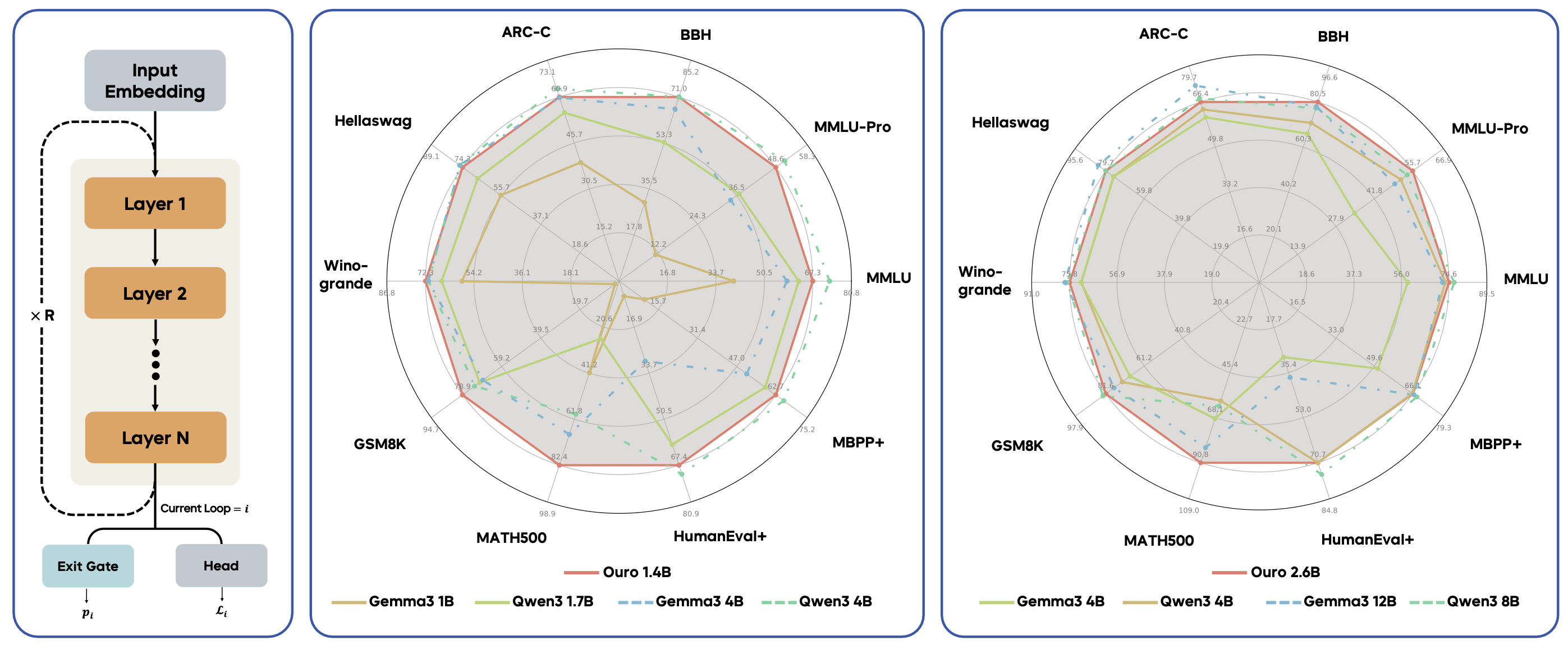
The weird finding: single-layer duplication does nothing. Too few layers, nothing. Too many, it gets worse. Only circuit-sized blocks of ~7 layers work. This suggests pretraining carves out discrete functional circuits in the layer stack that only work when preserved whole.
The whole thing was developed on 2x RTX 4090s in my basement. I'm now running current models (GLM-4.7, Qwen3.5, MiniMax M2.5) on a dual GH200 rig (see my other post). Code and new models coming soon.
Happy to answer questions.
MoE notwithstanding, a model trained on the whole Internet and a few hundred thousands stolen books carries way more knowledge than is actually needed for any given workflow. It would be great if we could ship slimmed down models into which we'd plug the knowledge banks useful for today's work, and only those.
It would also mean that you could keep a model's knowledge fresh without retraining the whole of it.
plugs in knowledge bank LLM: ... I know kung fu.
Have you tried a simple inline loop over the duplicated layers? Would be interesting to see performance. Also, would be interesting to compare with a MOE model. See if these layers are acting like different agreeing "experts" or if there is reasoning happening in the latent space.
I think this hasn't been tried before because it's totally unintuitive that feeding the output from later layers into previous ones would actually do anything. And in fact, it usually is detrimental. I guess it takes really bored hobbyists with too much compute to check this stuff.
I have done some interesting work on applying multiple layer duplications in different regions of the model too, going so far as to train a meta-model (actually just XGBoost) to predict the merges. Seems to work, buts thats a whole other blog post.
This works with MoE, and yes, I would be interested in looking into this in more detail. But my wife might disagree with this time sink...
Normal:
L1 -> L2 -> L3 -> L4 -> out
L1 -> [L2->L3] -> [L2->L3] -> L4 -> out
       --<--loop----
       |           |

  L1 -> [L2->L3] x N --> L4 -> out
Note: ascii rendering HN is not trivial
See the left-hand side of the diagram here, which is your exact proposal:
Great read, makes you wonder what else is encoded in these models that might be useful!
It less 'tool', than an assorted set of scripts, tailored to my unusual hardware setup. But it should be easy to extend; I would have released this earlier but I had the (stupid) idea to 'write a paper' on this. Aiming for that delayed this a year. Blogs are the way to go (for me).
Extra thanks for making it written in a readable and approachable way! I don't have much of a background in this topic, but still managed to understand about 70-80% of it :) You're a good writer
Pretty cool though. LLM brain surgery.
I really think from the experiments that 'organs' (not sure what to term this), develop during massive pretraining. This also means maybe looping the entire models is actually not efficient. Maybe a better way is [linear input section -> loop 1 -> linear section -> loop 2 -> linear section -> ... -> loop n -> linear output]?
This would give 'organs' space to develop.
finding them on the other hand is not easy! as you've shown, i guess brute force is one way.. it would be nice to find a short cut but unfortunately as your diagrams show, the landscape isn't exactly smooth.
I would also hypothesize that different circuits likely exist for different "problems" and that these are messy and overlapping so the repeated layers that improve math for example may not line up with the repeated layers that improve poetry or whatever, meaning the basic layer repetition is too "simple" to be very general. that said you've obviously shown that there is some amount of generalizing at work, which is definitely interesting.
Still the result is really interesting being able to stack abstract reasoning and get better performance and the heat maps to show the prob results
The academic literature seems to be catching up:
- *[SOLAR / DUS (Kim et al., 2023)](https://arxiv.org/abs/2312.15166)* — duplicated transformer layers to build a 10.7B model that outperformed 30B parameter baselines.
- *[The Curse of Depth (2025)](https://arxiv.org/abs/2502.05795)* — explains why this works: Pre-LN causes deep transformer layers to converge toward identity functions, meaning middle layers are where real computation happens, and duplicating them concentrates that capacity.
- *[Scaling up Test-Time Compute with Latent Reasoning: A Recurrent Depth Approach (Geiping et al., NeurIPS 2025)](https://arxiv.org/abs/2502.05171)* — takes the idea to its logical conclusion: a model trained with a single recurrent block repeated at inference time, scaling reasoning depth without adding parameters.
There's a video on YouTube https://www.youtube.com/watch?v=pDsTcrRVNc0
about a looping layer models, after watching that I poured some thoughts off the top of my head into a comment which, of course, promptly sunk without a trace. I'll repost the gist of them here.
If you gain benefit from looping layers, at some level every layer of parameters is in front of and behind every other, the conclusion must be that the order of the layers does not need to be fixed at all.
If you cycle through the layers multiple times, are you doing so for the benefit of a particular layer on a particular problem. If so, can you skip the other layers that don't add on repetition. If you can skip (and you can know when to skip), and you can repeat (and know when to repeat)
What you would need is a mechanism which can decide which layer is needed next. Is that then not a looping single layer MOE model? Storing the layers as a wide set of selectable options rather than a deep set of unconditional layers. You would be picking what the next layer should be (or exit the loop) the threshold for exit drops each iteration so it always eventually exits. With a tunable 'how hard to think' knob to adjust the threshold.
But we could still try it out: randomize the order we call the transformer blocks, and see if it affects performance. If not, that’s extremely interesting.
Another very interesting thing would be modulating compute at the token level. Default is 0 loops, maybe 1 loop is better, and 10 loops is even better than that.
This wasn't something I really dug into in great detail but I remember my surprise back then at how all those merged models and those "expanded" models like Goliath still generated coherent output. IMO those were more community models made by small creators for entertainment rather than work, and only really of interest to the local LLM groups on Reddit, 4chan, and Discord. People might briefly discuss it on the board and say "that's cool" but papers aren't being written and it's less likely for academics or corpo researchers to notice it.
That being said I wonder if it's possible to combine the layers of completely different models like say a Llama and a Qwen and still get it to work.
Even with math probes, I hit unexpected problems. LLMs fail arithmetic in weird ways. They don’t get the answer wrong so much as get it almost right but forget to write the last digit, as if it got bored mid-number. Or they transpose two digits in the middle. Or they output the correct number with a trailing character that breaks the parser.
Would using grammar parsing help here by forcing the LLM to only output the expected tokens (i.e. numbers)? Or maybe on the scoring side you could look at the actual probabilities per token to see how far the correct digit is.
The code in the blog helps derive useful metrics from partial answers.
Author is right about the base64 part. Does seem weird that it can decode and understand it at same time. And I guess what makes it weird that we just sorta accept that for say English and German this works ie normal use but when framed as base64 then it suddenly stops feeling intuitive
They almost certainly have never seen regular conversations in Base64 in their training set, so its weird that it 'just works'.
Does that make sense?
You could make the argument it's closer to the blocks of a CPU compared with a brain, and it's no different to copy-pasting some IP block for eg, HW JPEG decoding. But I feel like the difference here is we're 'discovering' these blocks / organs. They weren't designed, they were evolved.
You can enter the setting, and apply new re-layering architectures. Its very weird chatting with these brain-damaged models.
It would go from a normal description of the item in the picture to suddenly seeing people clapping in the background that were not there, or making up some other stuff. I kinda stopped after a while, but I should pick that back up and do a more coherent experiment to see if I can find any correlation between vector dimensions and "meaning."
"And now for the weirdness: There was never the case where any Transformer layer would have seen the output from a future layer!
Layer 10 is trained on layer 9’s output distribution. Layer 60 is trained on layer 59’s. If you rearrange them — feeding layer 60’s output into layer 10 — you’ve created a distribution the model literally never saw during training.
The astounding thing about Goliath wasn’t that is was a huge leap in performance, it was that the damn thing functioned at all. To this day, I still don’t understand why this didn’t raise more eyebrows.
Experimentally, this proved that layers were far more interchangeable than anyone had reason to expect. The internal representations were homogenous enough that the model could digest out-of-order hidden states without collapsing. The architecture was far more flexible than a rigid pipeline.
Between the Base64 observation and Goliath, I had a hypothesis: Transformers have a genuine functional anatomy. Early layers translate input into abstract representations. Late layers translate back out. And the middle layers, the reasoning cortex, operate in a universal internal language that’s robust to architectural rearrangement. The fact that the layer block size for Goliath 120B was 16-layer block made me suspect the input and output ‘processing units’ sized were smaller that 16 layers. I guessed that Alpindale had tried smaller overlaps, and they just didn’t work.
If that was true, maybe I didn’t need to teach a model new facts to make it smarter. I didn’t need fine-tuning. I didn’t need RLHF. I just needed to give it a more layers to think with."
I think that these models have to learn to efficiently use their parameters, and the best way to do that is 'evolve' (yes, a bad word for it), structures over pretraining time. Unfortunately, they don't have a way to access these structures 'from the inside'. I hope this new approach lets up boost performance in s more experimentally rigorous way
If the gain comes from giving the model another pass over its internal representation, I'd expect some sort of diminishing-returns curve as you add more repeats. But if those layers form a spevific circuit, running it multiple times might actually break the computation.
It would be really interesting to see which of those regims the model falls into.
I tried that pretty early on, the its basically never good. Its described in the the section: https://dnhkng.github.io/posts/rys/#the-beginning-of-llm-neu...
First pass runs your input through, second pass runs it's output as input?
Just, in double check it presumably runs the entire stack while you're trying to skip the translation steps and only double check the logic?
Do you think karpathy's autoresearch would be useful here?
This sounds similar to the Kimi's mixture of experts architecture if I understood it correctly(likely I have not), can you comment on this ?
MoE (mixture of experts), is an architecture that forces sparsity (not all 'neurons' are active during the forward pass.
This is pretty much orthogonal to that; it works with dense and MoE models, by repeating 'vertical' sections of the transformer stack.
They are of course open to interpretation, but it suggest to me that the models develop 'organs' for processing different types of data, and without duplicating the 'whole organ' you don't get the benefits.
This is quite different to what you usually see, which is via layer ablation experiments. Thoughts?
I will make another post if the topic is popular; its pretty geeky though, even more than my usual blog posts...
Hopefully the cost per GPU will kick-it soon and we'll see people properly play, but frankly the "middle section" layers 2(ish) to (n-1)(ish) of a model can be shuffled up/down and left/right and still perform well.
The fun one will be an LLM router for LLM layers to apply the best reasoning to the best input so far, but frankly that would need the years and years of training that the author hints at.
The one that's still out of grasps is still how to combine/manipulate per-layer k,v caches into a globally coherent state. i.e. if layers can be moved up/down why can't the cached k,v be swapped/combined with different projections? global k,v caches work, but they have to be _huge_ in order to prevent model collapse even on something as simple as owt.