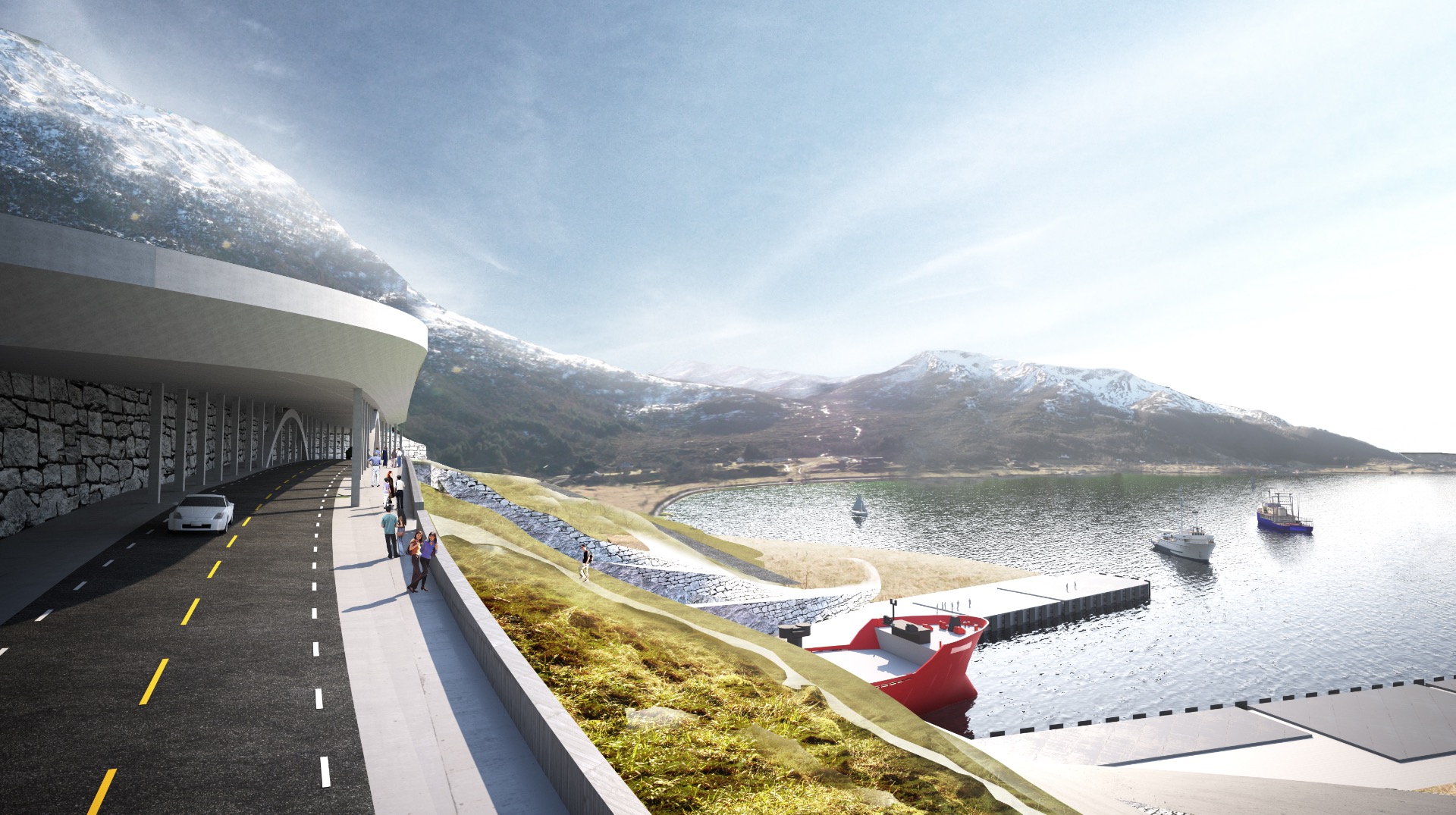
Yes, a failure of both the journalist and the editor.
Sadly, this kind of failure is all too common. I encounter articles that often omit a photo of the "thing" the article is describing. This (no photo) might have made some sense fifty years ago in the heyday of paper print where including a photo was much more work. But today, for HTML publishing, it is just an indication of failure on the part of the publisher.
However.
Ask a Norwegian to fix a piece of road and you will be staring at a hole in the ground for 4 years while people will take turns leaning on a shovel in that hole while surrounded by at least 4 different categories of supervisor or inspector.
But to inject some realism: if they say 4 years they can probably do it in 5. And it'll take another year or so to fix fuck-ups that in retrospect will look stupid and thoughtless, but which are realistically unavoidable. We'll whine about it. A lot. And each week the whole country will be experts on something new. Like evil-sounding compounds for stopping water ingress or how to insulate wires. And then suddenly it starts working.
I can think of a handful of projects that turned out like your example, California HSR and some nuclear plants. The vast majority of projects are completed on time.
You're saying the the general sense from the old germanic language cultures that dwarves and their ilk were somehow Scandanavian is rooted is a well-dug reality?
And “Full-size” means what? Sea-faring?
https://en.wikipedia.org/wiki/Canal_tunnel lists several tunnels that ships can pass through, and https://en.wikipedia.org/wiki/Rove_Tunnel, to me, seems to have supported decently sized ships.
From Wikipedia:
Rove:
    Length - 7,120 metres (23,360 ft) long
    Clearance - 15 m (49 ft)
    Width - 22 m (72 ft)
    Length - 1800 metres
    Clearance - 49 metres
    Width - 37 metres
    Boat-passable - 16 metres
Depth of tunnel below water level - 12 metreshttps://en.wikipedia.org/wiki/Naval_museum_complex_Balaklava
https://www.cnn.com/2020/08/21/asia/china-submarine-undergro...
The Rove Tunnel was designed for canal boats and barges, not ships. From a 1928 article:
"Barges are built for quiet waters, so their masters have looked with alarm at the prospect of taking them through the Mediterranean waves 25 miles from Marseille to the mouth of the Rhone. The new canal, after permitting barges to pass through the mountain, admits them to the Etang de Berre and thence to a canal which joins the Rhone at the famous old Roman town of Arles, 49 miles to the north" - https://archive.org/details/sim_national-geographic-school-b...
The desire for sheltered waters means these vessels were boats, not ships.
Looking through old articles and you'll see descriptions like "The 4½-mile Rove Tunnel floats barges and small boats" (https://archive.org/details/sim_national-geographic-school-b...) and " this tunnel will allow passage of river boats that previously found it practically impossible to negotiate the 30-mile sea trip from the mouth of the Rhone to Marseilles." (https://archive.org/details/sim_scientific-american_1928-01_...) but I found no mention of ships using the canal.
That said, "If you own a vessel in the UK that you intend to go to sea with" and the boat is "less than 24 metres in length overall" then you can register it in the UK Small Ship's Register (https://ukshipregister.co.uk/registration/small-ships-regist...), which technically means that something described as a "ship" could have gone through the canal.
But that's not really what people generally mean by ship.
This one a bit special: most of the boat traffic through it are meant to be ferries so it is to be commissioned and managed by the National Road Authority. At the same time it's quite unique if only due to enormous cross-section and can't share many usual national design solutions for the tunnels. For instance my company was asked a quotation for a PA system for it and it's really a challenge. So it's no wonder that it's delayed so much: it requires a lot of bespoke solutions.
For example a train station doesn't just serve the current people who live there, but the new town and all the new buildings that will be built around it as well. Infrastructure improves land value often by many orders of magnitude more than it costs to build.
No doubt it will cost a ton and be derided as a boondoggle/used as justification for austerity by the conservative wing which indirectly made it happen.
See map: <https://en.wikipedia.org/wiki/Stad_Ship_Tunnel#/media/File:S...>.
That said, I'm not finding any discussions of the hydrodynamics of the tunnel, other than this: "Ship Manoeuvring Study of a Vessel Transiting a Ship Tunnel", by Andrew Ross, Anne Bruyat, Leiv Aspelund, Vahid Hassani, and Abushet Simanesew (2024) <https://asmedigitalcollection.asme.org/OMAE/proceedings-abst...>.
You can see a copy of that last image (3rd in the gallery) from 2017 at https://web.archive.org/web/20170707052808/https://www.ship-... and at https://newatlas.com/stad-ship-tunnel-interview-terje-andrea... .
A copy of the first image in the gallery is at https://dozr.com/blog/stad-ship-tunnel dated 2021.
Edit: ahhh, 2017 and 2021 were the previous two big announcements about the tunnel. See my notes at https://news.ycombinator.com/item?id=48597546 .
It's memeable in many cases.
P1 "AI pictures are bad"
P2 "But AI was trained on human pictures"
[Human picture]
There are more images like [1] that are just the cheap 3d renders, with less of the photoshop butchery
https://newatlas-brightspot.s3.amazonaws.com/archive/snohett...
It correlates often enough.
"A plan to build a ship tunnel" (2017), at http://newatlas.com/stad-ship-tunnel-interview-terje-andreas... with 29 comments at https://news.ycombinator.com/item?id=13920841
"First ship tunnel to be built under Norwegian mountains" (2021), at https://edition.cnn.com/travel/article/norway-ship-tunnel/in... with 25 comments at https://news.ycombinator.com/item?id=26540805
See also gCaptain at https://gcaptain.com/worlds-first-ship-tunnel-to-bypass-dang... from 2017 and https://gcaptain.com/norway-gives-green-light-for-worlds-fir... from 2021.
> The Stad Ship Tunnel (Norwegian: Stad skipstunnel) is a planned canal and tunnel to bypass the Stad peninsula in Stad Municipality in Vestland county, Norway. The peninsula is one of the most exposed areas on the coast, without any outlying islands to protect it from the weather. The section has traditionally been one of the most dangerous along the coast of Norway.
> The surrounding waters, known as the Stadhavet Sea, is the most windswept part of the nation's coastline and is stormy around 100 days of the year, leading to ships often waiting days to pass through.[6][7] Currents, created by the area marking the meeting point of the North Sea and the Norwegian Sea further complicate navigation: Since World War Two ended, 33 deaths have occurred in maritime accidents within the Stadhavet Sea.[5] The official Visit Norway website has claimed Vikings would drag their boats over the peninsula to avoid crossing the dangerous patch of sea.
Though, to be fair, there are a lot of places with silly names like that. From what I have heard "Sahara Desert" translates to "Desert desert" for example. I seem to remember there is even a place that translates as "hill hill hill" somewhere in UK, using three different languages.
You might be thinking of Torpenhow. It's not clear the etymology actually supports the "hill hill hill" (I thought it did). But there are enough silly names like that for a Wikipedia list:
https://en.wikipedia.org/wiki/List_of_tautological_place_nam...
Quite a few of the English ones are incidentally down to either Norse or Germanic influence. E.g. most island names ending in "-ey" (compare -øy) that has gotten "island" added, like Canvey island.